TOKYO (Reuters) – Akihiro Adachi, a 31-year-old audiovisual equipment designer at Panasonic Corp, longed for some personal space during his lengthy train rides from Osaka to Tokyo. So when his company set out to encourage innovation, he joined with some colleagues and came up with “Wear Space,” a headset that limits noise and peripheral vision.
A designer of Panasonic demonstrates a prototype of ‘Wear Space’ during a photo opportunity in Tokyo, Japan, October 29, 2018. Picture taken October 29, 2018. REUTERS/Kim Kyung-Hoon
Many at Panasonic were puzzled.
“Someone said the office full of people wearing this would look weird,” said Kang Hwayoung, another member of the 10-person design team.
But the prototype unexpectedly won a global design award and received positive feedback from unexpected quarters, such as sake tasters who wanted to limit sensory input.
The project is among a range of efforts in the Japanese electronics industry to reinvigorate industrial design. After years of losing ground to design-first rivals such as Apple and Dyson, Japanese companies are now trying to recover the processes and creative flair that produced iconic products such as the Walkman.
Panasonic, Sony and Mitsubishi Electric are among those implementing practices that have been routine at many U.S. and European companies, such as engaging designers at every step and treating packaging as part of the product.
“We used to have designers involved only in final stages of our product development process, just for an aesthetic fix,” Yoshiyuki Miyabe, Panasonic’s technology and manufacturing chief, told reporters. “We are revamping the process so that designers can join us from the planning phase.”
The Japanese government is promoting the efforts: a report in May urged corporate executives to pursue “design-driven management, whereby a company leverages design as a primary driver of competitiveness.”
It also called for tax incentives for design-related investments and new laws to better protect intellectual property. The government is set to revise such laws next year.
“Of course, we had an argument over how much the government can do and should do with private-sector issues like this,” said Daisuke Kubota, director at the government’s design registration system planning office, who was involved in the panel.
“But a lot of design experts asked us for government initiatives, saying that this is really the last chance and Japan would never be able to catch up with global rivals if this opportunity is missed.”
Another member of the panel, Kinya Tagawa, visiting professor at the Royal College of Art and co-founder of design firm Takram, says there has been a sharp increase in major companies’ requesting design lectures for their executives.
“I’m seeing a sign of change,” he said.
THE ROAD AHEAD
All agree there is a long way to go. C-suite designers remain a rarity at most electronics companies while technologists reign supreme, company officials and industrial designers say.
Japan last year received 31,961 applications for design registrations, only a fraction of China’s 628,658 and half of South Korea’s 67,374. In the heyday of the Japanese electronics industry in the early 1980s, Japan had nearly 60,000 applications every year.
Tagawa said the root of today’s problems was the failure of Japanese firms to absorb lessons from the software revolution, which showed the importance of user-centered design principles and easy-to-use products such as Apple’s iPhone. Instead, they remained fixated on engineering.
Ryuichi Oya, who retired as design chief of Sharp Corp last month, says he saw that attitude up close when he moved to Sharp four years ago after a long stint at automaker Mazda Motor.
“Designers at home electronics companies have little say compared to engineers,” he said. “When engineers dismiss design proposals as too costly or difficult from an engineering point of view, designers easily succumb.”
Oya said he found it particularly hard to convince management of the need for a design vision.
“It’s not about whether you like this color or that shape,” he said. “There have to be design principles unique to Sharp and consistent across its product line.”
COMPETITION
Japanese designers cite the contrast with South Korea’s Samsung Group, where its patriarch, Lee Kun-hee, said in 1996 that design was a core management resource “imperative for a company’s survival in the 21st century.” He sharply boosted both the number and status of designers.
At Sony, insiders say design began its return to the forefront after chairman Kaz Hirai took over in 2012. Change has been slow as the company went through a painful restructuring, but the results can be seen its approach to the revival of Aibo, a robot dog.
Designers worked to craft a holistic user experience, starting from the moment a customer opened the box, tapping into a community of Aibo owners, Sony design chief Yutaka Hasegawa said.
“We had intense discussions over how Aibo should be packaged, to make it look closer to a living creature. It’s important because opening the container box marks the customer’s first encounter with the dog.”
Slideshow (6 Images)
They decided to lay Aibo sideways with its head tilting to the left, a more expensive option than placing it face down because the interior packaging must be asymmetrical.
The result was a buzz among Aibo owners, with some posting on the Internet videos showing a “ceremony for opening the Aibo container.”
($1 = 112.7200 yen)
Reporting by Makiko Yamazaki; Additional reporting by Yoshiyasu Shida; Editing by Jonathan Weber and Gerry Doyle
Over the past five years, Justin Benson and Aaron Moorhead have released a trio of amazing low-budget sci-fi/horror films: Resolution, Spring, and The Endless. Science fiction author Christopher Cevasco says that what sets these films apart is their focus on compelling characters.
“The performances have to be really strong to pull off movies like these,” Cevasco says in Episode 339 of the Geek’s Guide to the Galaxy podcast. “They’re not reliant on special effects or crazy visuals. You’re immediately pulled in by the characters.”
Benson and Moorhead are real-life friends, which definitely shows in the way that they portray male friendship. For writer Sara Lynn Michener, that’s a welcome change from horror movies in which the characters are both disposable and detestable.
“I really appreciate that they are putting a lot of emotionally intelligent male characters in their films,” she says. “We see a lot of stereotypical male behavior in film, and it’s really lovely to see a film about a man taking care of his friend.”
Geek’s Guide to the Galaxy host David Barr Kirtley hopes to see more low-budget sci-fi films like The Endless. “I just think this should be so inspiring to other filmmakers, that you can make movies like Resolution for $3,000 and have 92 percent on Rotten Tomatoes,” he says. “This is a model for other people who want to do that.”
Benson and Moorhead are currently at work on a bigger-budget movie, Synchronic, starring Jamie Dornan and Anthony Mackie. TV writer Andrea Kail hopes the new film is able to maintain the same sensibility as their earlier work.
“I just hope they retain their creative independence, because they’re amazing storytellers, and that should be encouraged, and not reined in by a bunch of idiot studio executives,” she says.
Listen to the complete interview with Christopher Cevasco, Sara Lynn Michener, and Andrea Kail in Episode 339 of Geek’s Guide to the Galaxy (above). And check out some highlights from the discussion below.
Andrea Kail on film school:
“Let me say this—and I’m sure NYU will come after me now—but if you want to be a filmmaker, don’t go to film school. Just don’t. It’s useless. You’re wasting your parents’ tens of thousands of dollars. All you need to do to figure out how to make a great film is watch movies—watch a ton of movies, read the scripts. You can download a million scripts off the internet. Watch the movies, read the scripts, take it apart, deconstruct it, figure out how it works, put it back together—like an El Camino on your front lawn. That’s how you figure out how to be a filmmaker, that is the way to do it. Don’t waste your parents’ money, don’t go to film school. It’ll ruin you.”
Sara Lynn Michener on religion:
“I went to Vacation Bible School growing up, and I was watching [The Endless] thinking, ‘Nope, this is terrifying.’ I always wonder whether it’s more terrifying for me or for anyone else who was raised in a restrictive thought environment, because there’s a very thin line between Vacation Bible School—which is this super-happy friendly innocent thing—and cults where people just decide to kill themselves. There’s a very thin line between those things. So I love movies that explore the horror of groups of people that get together and formulate these terrifying ideas. But yeah, the cult was totally believable to me.”
Christopher Cevasco on H. P. Lovecraft:
“There are some overt references [in The Endless] describing this entity as something we can’t quite see because its colors are off of our spectrum, and so of course those are all references to ‘The Colour Out of Space,’ which is a short story by Lovecraft. It’s about a meteor that crashes in a farm district and starts driving all the people in the area mad, turning the livestock into monstrosities and making all the vegetation really big and overgrown but also rotten and disgusting. A lot of those themes were used in the movie Annihilation which came out last year—I think Jeff VanderMeer is explicitly playing with a lot of the themes from ‘The Colour Out of Space’ in his book that the movie was based on. So there are definitely a lot of overt references to that.”
Andrea Kail on Hollywood:
“When you make an indie film, you’re the creator, and you have creative license because you’re not beholden to anybody. The minute you make a studio film, you are accountable to a bunch of accountants and a bunch of mid-level studio executives who went to the Peter Stark program at USC and then took a McKee seminar and suddenly think they’re film geniuses, and then they start giving you notes and telling you what to do. That’s what I fear. I hope it doesn’t go that way, because [Benson and Moorhead] have a very clear voice and they know what they’re doing, and I hope some dingbat 27-year-old kid doesn’t go, ‘Well I think it should be this.’”
The universe does not believe in Christmas, though this photo of a stellar nursery called NGC 346 might remind you of a seasonal decoration. It’s actually a combination of images: NASA’s Spitzer Space Telescope provided the infrared, the ESO’s New Technology Telescope added the visible light spectrum, and the European Space Agency’s XMM-Newton spacecraft sent in the x-ray. Clusters like these, dating back to just a few billion years after the Big Bang, are the source material for scientists looking to understand star formation, and by combining data from several telescopes they gain a better understanding on the goings-on at these nurseries.
Two’s the charm: You’re looking at a white dwarf and a red giant, a binary star called R Aquarii. As they orbit, material gets sucked from one star to the other, creating these tendrils of gas and dust. The European Southern Observatory’s Very Large Telescope has a new instrument called SPHERE (short for Spectro-Polarimetric High-Contrast Exoplanet Research), and it’s primarily for hunting planets, but it ran a system test on this stellar pair.
More R Aquarii from the ESO’s Very Large Telescope, this time from 2012, with rather different details visible on the nebula surrounding the pair. While the white dwarf hoovers material from its partner, the red giant spews out loops that can be seen here in red. So the stars’ relationship isn’t exactly mutual. Like George and Martha from Who’s Afraid of Virginia Woolf, this couple may seem charming, but don’t let that fool you.
Zooming out quite a bit, let’s take a distant view of R Aquarii courtesy of the ESO’s Digitized Sky Survey 2. The pair of stars can be seen right at the center of the image as a bright orange dot. Even at this remove, you might notice the red loops of gas jutting out from the sides of the stars.
Cut loose, Speculoos: In the clear-skied Atacama desert of Chile, ESO astronomers built a prototype telescope to search for Earth-sized, potentially habitable planets orbiting smaller stars. For its starter snap, Speculoos appears to have done a splendid job with M83, otherwise known as the Southern Pinwheel galaxy, a bright barred spiral about 15 million light years away.
Jupiter’s coming atcha! This photo series comes from Juno last April—April Fools’ Day, to be exact. The changing angle in each image offers a sense of the spacecraft’s trajectory as it flew past the planet. There’s the bright, famous, always-be-photobombing Great Red Spot, but the white, gray, and brown undulating clouds that encircle the gas giant are mesmerizing in their own right.
In September, Amazon announced plans to launch an Echo-powered wall clock to help users visually track their timers.
Today, the clock officially became available to the masses.
On the surface, it looks like any other wall clock. The device, however, has 60 LEDs around the clock face to show any active timers you’ve initiated.
For example, if you set a timer for when you need to take a pie out of the oven and another for when your kids absolutely need to stop playing video games and get ready for dinner, you’ll see two LEDs on the clock.
While the clock sports the Echo name, you’ll need to have Alexa set up on another device such as an Echo Dot or your phone to use it. The clock itself doesn’t have any speakers or microphones. It’s meant to work in tandem with another Echo device.
You can snag one of the wall clocks from Amazon for $29.99.
And if you want something a little different, that Billy Big Mouth Bass Echo device has a speaker and microphones, so it works like a traditional Amazon Echo and is definitely bound to start a few conversations with your guests this holiday season.
Following a successful test launch of Virgin Galactic’s SpaceShipTwo Thursday, Richard Branson said he’s planning on heading up to space “in the middle of next year” and that space tourists will also make the trip shortly afterward.
Thursday’s test, the fourth so far by Virgin Galactic, carried two pilots and a passenger dummy on a spacecraft more than 50 miles into the air, high enough to meet the Federal Aviation Administration’s definition of space. Afterward, Branson was asked on CNBC when the company would start ferrying human passengers.
Branson said that SpaceShipTwo would first be examined to see if changes are needed before facing a few more rounds of tests. “Then we will move the operation to a space port in New Mexico,” he said. “Then I will then go up, and we’ll do another set of tests. If every box is ticked we will start to be able to take members of the public up.”
In the past, Branson noted, his timing estimates have erred on the side of the optimistic. “I always get these estimates wrong. It’s been 14 years to get to this stage. I thought it would be seven,” he said. “But I would hope sometime in the middle of next year, I’ll be going up and quite soon after that members of the public will go up.”
The cost of a trip on a Virgin Galactic spacecraft has been estimated to be between $200,000 and $250,000. In the interview, CEO George Whitesides said that the price for early trips might be higher than that range, although the company hopes it will eventually be lower in the longer term.
To accommodate more passengers, Virgin Galactic is building two more spaceships. Branson said all three may be taking humans to space “in the not too distant future.”
FILE PHOTO: A Starbucks store is seen inside the Tom Bradley terminal at LAX airport in Los Angeles, California, United States, October 27, 2015. REUTERS/Lucy Nicholson/File Photo
(Reuters) – Starbucks Corp (SBUX.O) said on Thursday it was partnering with UberEats for delivery from about 3,500 U.S. stores and would nearly double its outlets in China over the next four years, but forecast that same-store sales would remain steady, sending shares down 3 percent.
The company said it expects its global same-store sales growth between 3 percent and 4 percent annually in the long term, roughly in line with a forecast that estimates sales growth to be at the lower end of 3 percent to 5 percent this year.
Starbucks has been struggling to lure diners to its restaurants as it faces severe competition from smaller coffee chains that offer exotic coffees as well as fresh food.
In its attempt to withstand competition, the Seattle-based chain that owns about 14,000 restaurants in the U.S. has been revamping its owned and licensed businesses, improving delivery, closing Teavana stores, laying off workers and adding new food as well as drinks to its menu.
The latest delivery initiative, which will commence from the beginning of 2019, builds on a pilot program launched in Miami in September, the company said.
The company said last month it was partnering with UberEats to deliver coffee and food in Tokyo, as part of its plan to boost sales in Japan, one of its major Asia-Pacific markets.
Starbucks also said on Thursday it would raise its store footprint in China, its fastest growing market, to 6,000 stores across 230 cities over the next four years, up from 3,600 stores in 150 cities.
Starbucks has partnered with Alibaba Group Holding Ltd (BABA.N) earlier this year for delivering food and coffee in China, as it looks to compete with local coffee chains.
The world’s biggest coffee chain’s shares were down 3 percent at $64.84 in after-hours trading.
Reporting by Aishwarya Venugopal and Nivedita Balu in Bengaluru; Editing by James Emmanuel
(Reuters) – Give me bitcoin or your life. Seriously?
FILE PHOTO: A collection of Bitcoin (virtual currency) tokens are displayed in this picture illustration taken December 8, 2017. REUTERS/Benoit Tessier/File Photo
The people behind a rash of bomb threats made across the United States and Canada on Thursday demanded a $20,000 ransom to be paid in bitcoin. Authorities said none of the threats – emailed to hundreds of businesses, public offices and schools – appeared credible.
Frankly, the perpetrators would have been better off asking for Turkish lira.
Bitcoin and other cryptocurrencies have long been a favorite ransom tender for cyber criminals thanks to the currencies’ anonymous nature. U.S. cyber security firm Chainalysis estimates that from 2012 through 2017, global ransom payments using bitcoin totaled at least $31 million.
Anonymity aside, of course, the big appeal was an incredible run-up in bitcoin’s value over that time. It shot from $5 a coin at the start of 2012 to nearly $20,000 at this time last year, according to data from Bitstamp, one of the larger bitcoin exchanges.
Today? Not so hot.
Bitcoin on Thursday was trading at around $3,250, down more than 80 percent from its record high. In the last three months alone it has plunged 50 percent.
Even the currencies of some crisis-hit economies like Turkey have done better: The lira is up 30 percent since August.
WASHINGTON (Reuters) – The U.S. International Trade Commission (ITC) said on Wednesday it would review a ruling that a ban on imports of some iPhones into the United States was not in the public interest, even if Apple Inc (AAPL.O) infringed a Qualcomm (QCOM.O) patent.
FILE PHOTO: People look at iPhones at the World Trade Center Apple Store during a Black Friday sales event in Manhattan, New York City, U.S., November 23, 2018. REUTERS/Andrew Kelly
Apple and Qualcomm are locked in a wide-ranging legal dispute in which Apple has accused Qualcomm of unfair patent licensing practices. Qualcomm has in turn accused Apple of patent infringement.
Qualcomm initiated the ITC case against Apple in July 2017, alleging that iPhones containing Intel (INTC.O) chips infringed six patents describing technology that helps smartphones perform well without draining the battery.
Qualcomm did not allege that Intel chips violate its patents, but that the way Apple implemented them in the iPhone does. It later dropped three of the six patents from the case.
Administrative law judge Thomas Pender, a now-retired member of the ITC tribunal that hears patent infringement cases, ruled in September that Apple infringed one of the patents, but cleared the company of infringing the other two.
Pender recommended the agency not grant Qualcomm the relief the San Diego, California-based chipmaker had sought, saying it was not in the U.S. interest.
The ITC said on Wednesday it would review whether the one patent was indeed infringed and also whether it was right to not grant Qualcomm relief. Pender’s decision on the other two patents would not be reviewed, it said.
The agency would also consider how long it would take Apple to design around Qualcomm’s patented battery-saving technology, what national security concerns would be implicated by an sales ban and whether a limited import ban could be adopted, it said.
“We are pleased that the Commission is going to review the Administrative Law Judge’s recommendation that no ITC remedy should result from a finding of infringement,” Don Rosenberg, Qualcomm’s executive vice president and general counsel, said in a statement after the announcement.
Apple declined to comment.
A final ruling is due before February 19, the ITC said.
Reporting by Jan Wolfe; Editing by Sonya Hepinstall
Never underestimate the market-moving potential of a nagging child. “Mom, Dad, I want THIS for Christmas!” is a phrase that each year leads to billions of dollars of toy sales. And it’s a phrase parents can appreciate, because knowing what your kid actually wants to find under the tree helps minimize Christmas morning tears. Toy manufacturers and retailers spend millions of dollars each year to make sure their products are the ones on everyone’s wish list, with TV and online ads, special retail displays, and old-fashioned toy catalogs.
The stakes are particularly high this holiday season, since one-time retail juggernaut Toys R Us closed all its US locations earlier this year. Even while its sales were declining, Toys R Us still accounted for around 12 percent of the estimated $27 billion total toy sales in 2017, according to Juli Lennett of NPD Group, the leading toy industry analysts in the US.
With Toys R Us gone, those sales are up for grabs, and Amazon wants them. The digital-first company was already beating Toys R Us in market share. And while it alone was not responsible for the demise of Toys R Us—poor business decisions and its sizable debt were also to blame—Amazon did put intense pressure on the toy store chain with extremely low prices, especially during the last few holidays seasons, using its familiar tactic of sacrificing profit for market share. Toys R Us couldn’t compete. Now Amazon hopes to feed from the carcass.
And so the e-commerce giant went retro this holiday season, mailing out its first-ever print toy catalog, like the one Toys R Us used to be known for. The “Holiday of Play” lookbook from Amazon is 68 pages long and features toys like the über-popular LOL! Surprise dolls, LEGO’s Star Wars Solo, and the Osmos Genius Kit for iPad. An Amazon representative told WIRED the catalog was sent it to millions of customers in November, but wouldn’t give exact numbers. It’s also available at Whole Foods, and some physical Amazon store locations, or online in PDF and Kindle form.
The catalog may be made of paper, but it’s designed as a gateway to a digital transaction. What it lacks in pricing information it makes up in QR codes and stickers that kids can use to make note of presents they want their parents to buy. It also works with the Amazon app: Take a photo of the catalog item you (or your kids) want, and the app will pull up the listing and let you buy it from your phone.
“The great thing about a catalog is that it sits on the coffee table, where kids can find it,” says Steve Pasierb, CEO of The Toy Association, a trade group representing American toy manufacturers. “The catalog is a market share play. Amazon has a huge chance to win a lot of those holiday sales.”
Amazon’s top competitors for Toys R Us’s sales are Target and Walmart, according to experts—traditional retailers that have mailed out holiday catalogs for years. And in the wake of Toys R Us closing, both companies decided to devote more shelf space in their retail locations to toys, says Pasierb. With only a handful of physical stores in a few major cities, Amazon’s toy push comes in the form of a dedicated landing page for kids on its website, and its catalog.
“They’re emulating a proven method of doing business, which is the catalog, but using their muscle to engage at a particular time when there are just fewer retailers now who sell toys,” says Richard Gottlieb, CEO of research firm Global Toy Experts. Gottlieb was impressed with Amazon’s catalog, though he far preferred eBay’s catalog full of weird and wild and expensive one-of-a-kind toys, which launched this season as well.
Amazon and eBay are joining the many other e-commerce companies still finding print catalogs have value in the digital era. Catalogs are harder to ignore than the clutter of online ads, one footwear startup founder told Digiday earlier this year, explaining that his company gets a slightly higher return on direct mail versus digital-only marketing. Companies can also use data to target catalogs to customers they know are likely to spend more money. And they are a traditional way for families to compile gift wish lists.
“I’m old enough to remember the Sears catalog,” says Gottlieb. “I remember laying on the floor just going through it. I didn’t get much anything out of it. But you know, marking things, studying it in detail. It was wonderful and a wonderful way to communicate with your parents what you want.”
People really want and love catalogs. Take a glance at the reviews for the Kindle version on Amazon’s website. Plenty of customers posted bad reviews, not because they didn’t like the catalog, but because they were annoyed that they didn’t get one.
“Why can’t we get a book and why didn’t we get one? We have been prime members for years, have 4 kids, buy lots of toys, and no book. And we can’t order one……,” reads the top-rated review right now. “Would love to have the toy catalog delivered through the mail. The children love looking at it and circling what they like. I dont use Kindle. I’ve been a prime member for many years and did not get one,” reads another. A review from November 15 is even more direct: “Disappointed that I didn’t and can not now get a hard copy in the mail even though I have two small children and spend a ton on toys through Amazon Prime. I AM YOUR TARGET MARKET. Speaking of Target – I’ll be doing my toy shopping there because I am THAT petty.”
The disappointment those Amazon reviewers felt speaks to the reason catalogs have worked so well. They’re convenient, above all. Enjoyable, even. And this time of year, when millions of Americans are going to buy toys, it’s easier for children to thumb through a physical catalog that feels like a big book of wonders than a notoriously hard-to-navigate website.
Kids, especially, don’t have a great way to discover toys on the actual Amazon website. Even its dedicated toy section divided by age group is confusing to navigate. And while the site does have a wishlist feature, parents might not trust their kid to trawl through Amazon’s website on their account, since they could accidentally push one button and buy something. A print catalog is a way for Amazon to directly get its offering in front of children, while also giving parents a little bit more control over the process.
The toy catalog is a familiar marketing throwback in an otherwise rapidly evolving industry. Pasierb notes that with the growth in streaming entertainment for kids, the kinds of ads children see have changed. “Unboxing videos, the online kind of stuff is for a lot of our toy companies as important or now more important than traditional television advertising. A lot of our companies that no longer do traditional TV advertising do almost all exclusively digital,” says Pasierb. The highest-paid YouTube celebrity this year, according to Forbes, was a 7-year-old boy making unboxing videos of toys, earning an estimated $22 million in 12 months.
“[These kinds of ads] are entertainment in their own right,” says Lennett. “A lot of these kids, I don’t think they know the difference between watching a show—a real show—versus watching another kid playing with a toy on YouTube.”
“In my household, the word ‘TV’ is gone. Now it’s just ‘shows.’ Children have already fully internalized the idea of on demand, and that disrupts the ad model completely,” says David Carroll, professor of media design at the New School.
But Carroll doesn’t let his two kids watch YouTube, where they might see those ads. I don’t let my three-year-old son watch it, either. We are the exception; a recent Pew survey found that 81 percent of parents do allow their young kids to watch YouTube. Our reasons are less to do with fear of seeing ads than fear that we can’t control the algorithm and our children might get exposed to inappropriate, creepy, or ideological videos. Instead, our kids mostly watch on-demand shows on Amazon Prime, Netflix, iTunes, or Google Play—and those are largely free of ads.
“The only way [Amazon’s toy offerings] are getting in front of my children is through a catalog,” says Carroll. Only Carroll never got an Amazon catalog, despite his prolific Prime usage. Neither did I. Neither did Lennett, who says, “I’m mad I didn’t get one.” Though her kids are teenagers, she buys lots of stuff on Amazon and thought they’d receive one in the mail, as some of her friends did. An Amazon representative declined to comment on how the company decided who to send the catalog to, though the person offered to send me one. (I declined.)
For Amazon, a catalog also fits well with its bigger push into the physical world, with everything from actual store locations to Dash buttons you physically push to order goods. “[Amazon owner Jeff] Bezos has total world domination as the goal. So from that perspective it makes sense that they would not take a digital-only approach. They would take a whatever works approach,” says Carroll.
For world domination, Amazon has to be everything. And everywhere. Even in the living room, where your kid can find it and come up to you whining, “Mom! I want this!” That is, if Amazon sent you one.
Kubernetes is a series of open source projects for automating the deployment, scaling, and management of containerized applications. Find out why the ecosystem matters, how to use it, and more.
What is etcd? No, it’s not what happens when a cat tries to type a three-letter acronyms. Etcd (pronounced et-see-dee) was created by the CoreOS team in 2013. It’s an open-source, distributed, consistent key-value database for shared configuration, service discovery, and scheduler coordination. It’s built on the Raft consensus algorithm for replicated logs.
Etcd’s job is to safely store critical data for distributed systems. It’s best known as Kubernetes’ primary datastore, but it can be used for other projects. For example, “Alibaba uses etcd for several critical infrastructure systems, given its superior capabilities in providing high availability and data reliability,” said Xiang Li, an Alibaba senior staff engineer.
When applications use etcd they have more consistent uptime. Even when individual servers fail, etcd ensures that services keep working. This doesn’t just protect against what would otherwise prove show-stopping failures, it also makes it possible to automatic update systems without downtime. You can also use it to coordinate work between servers and set up container overlay networking.
In his KubeCon keynote, Brandon Philips, CoreOS CTO, said: “Today we’re excited to transfer stewardship of etcd to the same body that cares for the growth and maintenance of Kubernetes. Given that etcd powers every Kubernetes cluster, this move brings etcd to the community that relies on it most at the CNCF.”
Must read
That doesn’t mean Red Hat is walking away from etcd. Far from it. Red Hat will continue to help develop etcd. After all, etcd is is an essential part of Red Hat’s enterprise Kubernetes product, Red Hat OpenShift.
Moving forward, etcd will only grow stronger. It being used by more and more companies, as Kubernetes is adopted by almost every cloud container company. In particular, Phillips said, he expects far more work to be done on etcd security.
I’m back stateside after a week-and-a-half stay in China, where I helped host Fortune‘s 2018 Global Tech Forum. I hope you understand the absence of last weekend’s dispatch; following the event, I took an impromptu vacation in Hong Kong. Thankfully, I did not stay at a Marriott hotel. Speaking of which.
As you have no doubt heard by now, Marriott disclosed a massive data breach that exposed up to 500 million customer records. Hackers accessed information in the company’s Starwood reservation system, which affected brands such as W Hotels, St. Regis, Sheraton Hotels & Resorts, Westin Hotels & Resorts, and other properties in the Starwood portfolio, the company said. The intrusion apparently began in 2014, two years before Marriott acquired Starwood. This oversight in the M&A process calls to mind another recent, post-acquisition hacker-surprise: Yahoo, whose two mega-breaches remained undetected when the company sold to Verizon last year. Coincidentally, Marriott’s hack is the biggest suffered by a corporation, second only to those at Yahoo.
After news of the Marriott breach came out, Sen. Charles E. Schumer (D-N.Y.) called on the hotel chain to foot the bill and replace people’s passports which were potentially compromised as part of the breach. Marriott quickly promised to cover the cost for as many as 327 million people whose passport numbers may have been exposed. At a fee of $110 per passport, that would put Marriott on the hook to pay up to $36 billion—a price tag equivalent to the value of the entire company, per its market capitalization. A devastating payout.
Here’s the thing though: While seemingly noble, Marriott’s promise is a bunch of baloney. The company said it will follow through on reimbursement only in instances where it “determine[s] that fraud has taken place.” What this caveat conveniently excludes is that Marriott’s hack likely had little to do with fraud and everything to do with espionage. In other words, if you’re a victim, don’t expect remuneration.
As Reutersreported, investigators believe the perpetrators of this attack were Chinese spies. The breach used tools, tactics, and procedures that matched Beijing’s style. The intrusion is said to have begun shortly after a breach of the government’s Office of Personnel Management, which government officials have attributed to China. The Starwood database represents a massive trove of potential intelligence: information on who is staying where, when—a bonanza for building up profiles of targets and tracking people of interest.
Geng Shuang, China’s Ministry of Foreign Affairs spokesperson, issued a statement saying the country “opposes all forms of cyber attack,” per Reuters. He said the country would investigate the claims, if offered evidence. Meanwhile, Connie Kim, a Marriott spokesperson, said “we’ve got nothing to share” about the Chinese attribution claim.
The Marriott breach—which took place quietly over years, as spies prefer—does not appear to have been a cybercriminal score. The passport payment pledge is probably bunk; nevertheless, if you think you might have been affected, it won’t hurt to follow these steps to refresh your cybersecurity hygiene and better protect yourself.
Have a great weekend.
Robert Hackett
@rhhackett
robert.hackett@fortune.com
Welcome to the Cyber Saturday edition of Data Sheet, Fortune’s daily tech newsletter. Fortune reporter Robert Hackett here. You may reach Robert Hackett via Twitter, Cryptocat, Jabber (see OTR fingerprint on my about.me), PGP encrypted email (see public key on my Keybase.io), Wickr, Signal, or however you (securely) prefer. Feedback welcome.
As you have no doubt heard by now, Marriott disclosed a massive data breach that exposed up to 500 million customer records. Hackers accessed information in the company’s Starwood reservation system, which affected brands such as W Hotels, St. Regis, Sheraton Hotels & Resorts, Westin Hotels & Resorts, and other properties in the Starwood portfolio, the company said. The intrusion apparently began in 2014, two years before Marriott acquired Starwood. This oversight in the M&A process calls to mind another recent, post-acquisition hacker-surprise: Yahoo, whose two mega-breaches remained undetected when the company sold to Verizon last year. Coincidentally, Marriott’s hack is the biggest suffered by a corporation, second only to those at Yahoo.
After news of the Marriott breach came out, Sen. Charles E. Schumer (D-N.Y.) called on the hotel chain to foot the bill and replace people’s passports which were potentially compromised as part of the breach. Marriott quickly promised to cover the cost for as many as 327 million people whose passport numbers may have been exposed. At a fee of $110 per passport, that would put Marriott on the hook to pay up to $36 billion—a price tag equivalent to the value of the entire company, per its market capitalization. A devastating payout.
Here’s the thing though: While seemingly noble, Marriott’s promise is a bunch of baloney. The company said it will follow through on reimbursement only in instances where it “determine[s] that fraud has taken place.” What this caveat conveniently excludes is that Marriott’s hack likely had little to do with fraud and everything to do with espionage. In other words, if you’re a victim, don’t expect remuneration.
As Reutersreported, investigators believe the perpetrators of this attack were Chinese spies. The breach used tools, tactics, and procedures that matched Beijing’s style. The intrusion is said to have begun shortly after a breach of the government’s Office of Personnel Management, which government officials have attributed to China. The Starwood database represents a massive trove of potential intelligence: information on who is staying where, when—a bonanza for building up profiles of targets and tracking people of interest.
Geng Shuang, China’s Ministry of Foreign Affairs spokesperson, issued a statement saying the country “opposes all forms of cyber attack,” per Reuters. He said the country would investigate the claims, if offered evidence. Meanwhile, Connie Kim, a Marriott spokesperson, said “we’ve got nothing to share” about the Chinese attribution claim.
The Marriott breach—which took place quietly over years, as spies prefer—does not appear to have been a cybercriminal score. That’s why the passport payment pledge is probably bunk; nevertheless, if you think you might have been affected, it won’t hurt to follow these steps to refresh your cybersecurity hygiene and better protect yourself.
A version of this article first appeared in Cyber Saturday, the weekend edition of Fortune’s tech newsletter Data Sheet. Sign up here.
FILE PHOTO: The Uber application is seen on a mobile phone in London, Britain, September 14, 2018. REUTERS/Hannah McKay/File Photo
(Reuters) – Ride-hailing company Uber Technologies Inc filed paperwork confidentially this week for an initial public offering next year, three people familiar with the matter said on Friday, setting the stage for what would be one of the biggest listings ever.
Uber’s most recent valuation was $76 billion.
One person said the filing was on Thursday.
That put it in lock step with smaller rival Lyft Inc, which also on Thursday filed for an IPO in a test of investors’ appetite for some of the most highly valued Silicon Valley companies and for the ride-hailing business. Uber has become a wildly popular service but has an uncertain future with a number of loss-making businesses.
Uber Chief Executive Dara Khosrowshahi had told Reuters in May that the ride-hailing company was on track to launch an initial public offering next year.
The Wall Street Journal reported the filing earlier on Friday.
Reporting by Ismail Shakil in Bengaluru; Editing by Sandra Maler
Two dozen Amazon warehouse employees in New Jersey were hospitalized Wednesday, one in critical condition, after a robot punctured a can of bear repellent, according to local reports. The news was soon picked up by national outlets and spread on social media, in part because it’s a perfect horror story for the year of our lord 2018.
In total, 54 workers at the Robbinsville, NJ, facility were exposed to fumes. Bear repellent is made with capsaicin, or chili pepper extract; many of the workers experienced trouble breathing and said their throats and eyes burned. All of the injured workers are expected to be released from hospitals soon if they haven’t been already, according to Rachael Lighty, a spokesperson for Amazon. “The safety of our employees is always our top priority,” she said in a statement. The Occupational Safety and Health Administration says it is conducting an investigation into the incident.
Wednesday’s mishap demonstrates the many hazards that workers must contend with in Amazon’s sprawling warehouses, where almost every product imaginable may be in stock—including aerosol cans of irritating spray for warding off bears. This particular accident comes with an added dystopian layer, since it was caused by one of the robots Amazon hopes will replace many of its human warehouse workers in the near future.
But things get much stranger when you realize this isn’t the first time a can of bear repellent has exploded in an Amazon facility. In 2015, the fire department responded to an accident at an Amazon facility in Haslet, Texas, that was caused by a robot running over a can of none other than bear repellent, according to public records unearthed by Jessica Bruder for her book Nomadland, which chronicles the lives of the retail giant’s older, transient workforce.
The New Jersey incident wasn’t even the first bear repellent accident at an Amazon facility in 2018! One employee at an Amazon warehouse in Indiana told WIRED that a can ruptured in his facility earlier this year. The worker says that accident was caused by someone dropping the can and they believe no injuries occurred. They think the way the product is packaged may be the issue; the employee adds that they, too, have dropped the repellent, though in their case it didn’t rupture. “It’s a clamshell that pops open when you pick it up,” says the employee. “What I can say is that our safety people are on it and they are top-notch.”
Lighty, the Amazon spokesperson, confirmed in an email that an incident involving bear repellent did occur at the Indiana facility earlier this year. She also confirmed the 2015 accident in Texas. However, she added, “I do not have exact information on the root cause of either scenario, only that they were different.”
It’s not just bear spray that can cause issues at Amazon. The mishap this week in New Jersey affected a particularly large number of people, but bizarre and tragic accidents happen at the company’s facilities on a regular basis, some more serious than others. In November, two Amazon contractors were killed when a wall inside a distribution center in Baltimore collapsed during a bad storm. Seven months earlier, two people suffered minor injuries at a facility in Ohio after a tornado ripped open a 100-foot hole in the roof. Last September, an employee at an Amazon warehouse in Pennsylvania was run over by a truck and killed.
Accidents happen often at Amazon in part because it’s one of the largest employers in the US. Fatal occupational injuries have also been on the rise across the country, according to the Bureau of Labor Statistics. Amazon does employ on-site medical contractors, at least at some facilities, according to another employee who works at an Amazon warehouse on the East Coast. They are equipped to provide basic medical care, in the case of minor illnesses and injuries. The worker said that a handful of medical staff work each shift at their facility.
Some experts say, however, that Amazon is a particularly dangerous place to work for other reasons. The National Council for Occupational Safety and Health, a labor advocacy group, announced in August that Amazon topped its annual “Dirty Dozen” list highlighting companies that it believes put workers especially at risk because of unsafe labor practices. The organization counted seven deaths that have occurred at US Amazon facilities since 2013, including three at separate locations in the span of five weeks in 2017. (The two Baltimore contractors who died in November would bring the number up to nine.) When the COSH report was released, an Amazon spokesperson told Business Insider in part that, “While any serious incident is one too many, we learn and improve our programs working to prevent future incidents.” The company added that it surveys employees each month to measure their perception of safety in their facility.
In the United Kingdom, ambulances were called over 600 times to Amazon facilities in the past three years, according to Freedom of Information requests filed by the the trade union GMB. A July report from The Guardian found that some Amazon workers have suffered injuries that left them unable to work, and in some cases, homeless.
The Robbinsville facility where Wednesday’s bear repellent accident happened has drawn scrutiny for other workplace safety issues. In 2016, OSHA issued Amazon a citation for failing to report at least 26 work-related illnesses and injuries there. “We take safety very seriously, we do not agree with the findings and will be contesting the citation,” an Amazon spokesperson told CBS Moneywatch at the time.
Have you witnessed a bear repellent-related incident at an Amazon facility? Contact the author at louise_matsakis@wired.com or via Signal at 347-966-3806.
AI has vast potential. The technology is being touted as a solution to some of humanity’s most vexing problems, and rightly so. In China, where there aren’t enough radiologists to review the 1.4 billion annual CT scans for lung cancer, algorithms can accurately and efficiently diagnose patients.
Around the world, the next generation of automobiles will be driven quite literally by AI, and removing angry, distracted, or drunk humans from behind the wheel will likely make the road a far safer place. Still, for every positive AI implementation, there’s a downside just waiting to be uncovered.
One of the principal concerns about AI stems from its potential to spread misinformation. Social media platforms such as Facebook and Twitter are already having to deal with this practice, and they’ve taken to shutting down bots designed to spread hate speech and inflame public opinion.
According to Greg McBeth, head of revenue at Node.io, what’s currently an annoyance will only continue to escalate: “I believe there’s potential for an AI-driven misinformation crisis in our lifetime. AI can already convincingly manipulate images and video,” McBeth noted, citing as an example instances in which some actresses’ faces were superimposed onto inappropriate photos. Unfortunately, fake news is just the beginning.
In addition to faking images and videos, programmers with malicious intentions will use AI to commit other crimes, from the forging of financial documents that impact credit to the fabrication of phony evidence to produce wrongful convictions. In order to combat these efforts, we need to take the following steps.
1. Start the conversation now.
Advancements in AI are accelerating, and the use of the technology for nefarious purposes will as well. While news coverage seems to emphasize the revolutionary possibilities of AI, we must not shy away from the potential consequences. Earlier this year, Facebook’s Mark Zuckerberg warned that it could be a decade before AI is able to recognize the nuances that allow it to red flag hate speech or false information.
AI’s more nefarious uses could greatly outpace AI-based countermeasures. As a business leader, you can help guide this conversation. For instance, you could set up a roundtable discussion at an industry conference to share information and increase awareness of how AI may be used to spread misinformation — and where the tech comes up short in detecting it.
2. Create safeguards for defense.
Science fiction author Isaac Asimov thought up his three laws of robotics with android servants in mind. We still don’t have robots doing our household chores (not counting vacuums), but the laws have withstood the test of time.
To prevent AI from causing harm, the business community needs similar, universally accepted safeguards that apply to AI development. For instance, if you intend to use robots, you may be tempted to simplify the interface required to control them in order to make them more user-friendly for your employees. But be careful to balance those efforts with attention to cybersecurity. It’s imperative to address system vulnerabilities that could make it easier for hackers to gain access to your robot and network.
3. Arm citizens with AI education.
In order to mitigate the damages of misinformation, the business community needs to educate the public about what AI is capable of, both good and bad. Include educational resources on this subject on your blog, website, email newsletter, and social media accounts. Inform your customers about your use of AI and what safeguards or policies you have in place to prevent cyberattacks.
When people are aware of ways AI can be used maliciously, they’re more likely to recognize the red flags. For instance, if someone knows how to recognize signs that a Twitter account is potentially a political bot, they may think twice before retweeting something it shared.
On the other hand, when people are ignorant of AI’s misuse, they won’t hesitate to propagate misinformation. This needs to be a society-wide effort, but you can start by working with your team and your customers so they know what AI can do.
AI is responsible for exciting developments, but it’s a powerful tool that can be used to do harm as well. Ultimately, it’s impossible to prevent bad actors from developing AI for their own ill-intentioned purposes. But by taking these steps, business leaders can help minimize the impact of AI’s downsides.
Not to worry, Yahoo, you still had the largest data breach in corporate history, at 3 billion records. But at 500 million, Marriott is a strong second, and maybe should be first.
That’s because of the nature of the data that went out the door for about 327 million of the people who had stayed at a Starwood property on or before September 10, 2018. (And starting in 2014, because that’s how long it’s been since someone first broke into the system.)
The data included some combination of name, mailing address, phone number, email address, Starwood Preferred Guest (“SPG”) account information, birth date, gender, arrival and departure information, reservation date, communication preferences, and passport number.
Passport number? Yup. They kept them on file. And an undisclosed number of encrypted payment card numbers, expirations dates, and maybe–Marriott’s really not quite sure–enough information to let someone crack the encryption.
Yes, this is really, really bad.
Oh, and TechCrunch also noted the the claim that Russian cybercriminals got into the Starwood servers. It can’t keep getting worse, right?
You know the answer.
Marriott’s promised email notifications to affected customers will come from a fake-ish looking email address, as TechCrunch noted, and one that could be easily spoofed by people who want to cause even more damage. In other words, beware of phishing hacks that stand on the back of Marriott’s efforts to address the terrible position it’s put so many customers into.
And now we come around to the latest insanity. As part of its response, Marriott set up a website that ultimately points you to a third party service that “monitors internet sites where personal information is shared and generates an alert to the consumer if evidence of the consumer’s personal information is found.”
The third party running the service, corporate investigations and risk management firm Kroll, of course is going to need information from you to see if it pops up on the dark web. Here is what they might want, directly from their website:
name, address, phone number, and e-mail address
date of birth, driver’s license number, social security number, passport number, and other similar information
copies of government-issued photo identification, Social Security card and/or utility bill(s), where applicable
credit card number and other financial account data, including your consumer credit file(s), as applicable
your responses to security questions; the information you provide in customer service correspondence; and general feedback
You’re going to have to cough up enough information to see if they can match it to anything on the dark web. You’ll have to trust that everything will be fine. Which is what you did with Marriott in the first place.
Fat lot of good that did almost half the country.
How does this keep happening? As I explained in a piece over at Vice Motherboard, it all comes down to economics. The ultimate penalties big companies pay are so infrequent and small in comparison to their revenues that it becomes something just as easy to ignore. The millions of dollars you may hear about as the cost of a data breach is significantly smaller than a rounding error in accounting to them.
Not that I’m suggesting Marriott is ignoring this. Just a comment on the general treatment of customer data security by large corporations.
The only hope is that government officials take enough heat from voters that they put significant fiscal punishment into place. I’d settle, at least in this case, for Marriott to pay the cost for all the people who might now need to obtain a new passport. That at least would be a start.
But there’s the other factor: consolidation. Marriott is the largest hotel operator in the world. If you’re traveling, there’s a good chance you’ll land in one of its properties. Unless, of course, you remember all this nonsense and intentionally stay elsewhere.
Even if you don’t get more points, you might at least keep your data secure.
(Reuters) – U.S. chipmaker Qualcomm Inc (QCOM.O) said on Monday it was not looking to revive its abandoned $44 billion acquisition of Dutch peer NXP Semiconductors NV (NXPI.O), a day after the White House said China would reconsider clearing a deal if it was attempted again.
Qualcomm, the world’s biggest smartphone-chip maker, walked away from its agreement to buy NXP in July, after failing to secure Chinese regulatory approval. The planned deal was first agreed between the two companies in October 2016.
Qualcomm, headquartered in San Diego, California, and NXP, based in Eindhoven, the Netherlands, needed China’s blessing for their deal because of their presence in that country.
After high-stakes talks on Saturday between U.S. President Donald Trump and Chinese President Xi Jinping in Argentina, the White House said in a statement that China was “open to approving the previously unapproved” deal for Qualcomm to acquire NXP “should it again be presented”.
But Qualcomm said there was no prospect for the acquisition to be revived.
“While we were grateful to learn of President Trump and President Xi’s comments about Qualcomm’s previously proposed acquisition of NXP, the deadline for that transaction has expired, which terminated the contemplated deal,” a Qualcomm representative said via email.
“Qualcomm considers the matter closed.”
NXP declined to comment.
On Monday, White House economic adviser Larry Kudlow told reporters that President Trump put the issue of the acquisition on the table in the talks with the Chinese president.
Kudlow added that the Chinese president’s openness to the deal was a sign of further cooperation on multiple issues, including corporate mergers. Xi’s reported comment could embolden some potential acquirers in the semiconductor space to explore transactions, corporate dealmakers said.
“Although that acquisition cannot be resuscitated, Xi’s comment reveals in plain sight that Chinese antitrust policy is inherently politicized,” said Scott Kennedy, a China expert at the Center for Strategic and International Studies in a blog post.
FILE PHOTO: A sign on the Qualcomm campus is seen, as chip maker Broadcom Ltd announced an unsolicited bid to buy peer Qualcomm Inc for $103 billion, in San Diego, California, U.S. November 6, 2017. REUTERS/Mike Blake
Qualcomm shares closed up 1.5 percent at $59.14 in New York on Monday, while NXP shares ended up 2.75 percent at $85.67.
Qualcomm and NXP did not lobby for the Trump administration to bring up the abandoned deal in its meeting with Xi and other Chinese officials on the sidelines of the G20 summit in Buenos Aires on Saturday, which was dominated by negotiations over trade tariffs, according to sources close to the companies.
The two companies were surprised to see that the terminated deal resurfaced as an issue, the sources added, requesting anonymity to discuss confidential deliberations. Qualcomm was given just an hour’s notice by the Trump administration about Xi’s comment on the NXP deal, and its inclusion in the White House statement, according to two of the sources.
The Trump administration had unsuccessfully lobbied the Chinese government earlier this year to give its blessing to the deal.
China’s foreign ministry declined to comment on Qualcomm during a regular media briefing on Monday.
Qualcomm had sought to purchase NXP because of its market position as a dominant supplier to the automotive market, as car makers add more chips to vehicles each year. Qualcomm is now focused on developing its own chips for the automotive market, according to one of the sources.
Qualcomm had to pay NXP a $2 billion fee to terminate the deal. To appease its shareholders, Qualcomm has also embarked on a $30 billion stock repurchase plan to return to them most of the money that would have been used for the NXP deal. It has spent more than $20 billion in share buybacks in the last 12 months. NXP has also announced its own $5 billion share buyback program.
DEALS ABANDONED
Several deals by semiconductor companies were put on ice after the Qualcomm/NXP deal fell through, simply because they had a footprint in China and required regulatory approval there. Now, chip companies may be more optimistic about their regulatory chances in China.
One example could be Xilinx Inc (XLNX.O), a U.S. provider of chips used in communications network gear and consumer electronics that has a big presence in China. Xilinx is currently vying to acquire Israeli chip maker Mellanox Technologies Ltd (MLNX.O) after it decided to run an auction to sell itself, according to people familiar with the matter. A successful acquisition of Mellanox could prove an important test of China’s appetite to approve such deals. A representative for Xilinx declined to comment. Mellanox did not immediately respond to requests for comment.
A more near-term test being watched by dealmakers is KLA-Tencor Corp (KLAC.O) pending acquisition of fellow semiconductor equipment maker, Israel’s Orbotech Ltd (ORBK.O). The $3.4 billion deal, announced in March, is still awaiting Chinese regulatory approval. KLA-Tencor’s CEO said on the company’s last earnings call that he expects the deal to close by year end.
Thus far, other high-profile mergers and acquisitions involving U.S. companies in other sectors have received Chinese approval. Last month, China approved United Technologies Corp’s (UTX.N) $30 billion purchase of aircraft parts maker Rockwell Collins Inc and Walt Disney Co’s (DIS.N) $71.3 billion deal to buy most of Twenty-First Century Fox’s (FOXA.O) entertainment assets.
Acquisitions of U.S. companies by Chinese companies, on the other hand, have been few and far between in the last year, after the Committee on Foreign Investment in the United States (CFIUS), a government panel that scrutinizes deals for potential national security risks, shot down more of these deals, such as Ant Financial’s plan to acquire U.S. money transfer company MoneyGram International Inc (MGI.O). U.S. lawmakers also passed reforms earlier this year that increased CFIUS’ scrutiny of deals.
Reporting by Liana B. Baker in New York and Kanishka Singh in Bengaluru; Aditional reporting by Greg Roumeliotis in New York, Michael Martina in Beijing and Jeff Mason in Washington, D.C.; editing by Diane Craft
FILE PHOTO: The logo of Amazon is seen at the company logistics centre in Boves, France, August 8, 2018. REUTERS/Pascal Rossignol/File photo
LAS VEGAS (Reuters) – Amazon.com Inc on Tuesday said it was starting a new antenna service for uploading and downloading data from satellites, in a bid to lure more space industry customers to the cloud.
The world’s No. 1 cloud computing company said it was aiming to make data transfers to and from satellites cheaper and easier through ground stations associated with its data centers across the globe. It listed Lockheed Martin Corp as one of the customers or partners already previewing the service.
“It’s not so simple dealing with satellites if you actually want to be able to upload and download data,” Andy Jassy, Amazon Web Services’ chief executive, said in Las Vegas announcing the service, which he called a “total game changer for how people can interact with satellites.”
Reporting By Jeffrey Dastin in San Francisco; Editing by David Gregorio
If you slept in yesterday, or were lucky enough to spend a day away from screens, you missed a bunch of sales. Cyber Monday is the epic conclusion to what has become an extended weekend of deals beginning with Black Friday (or Thanksgiving for some retailers and shoppers).
No big deal. We combed through our many Cyber Monday guides and found more than three dozen deals that are still active as of noon on Tuesday. These are all items we like here at WIRED. These deals tend to be volatile so we don’t know how long they will last, but have a gander if you’re still bargain hunting for the holidays.
TCL’s 5 Series 4K TV with Roku has all the basics of a good 4K HDR TV, with great picture quality and a better interface than some $1,000-plus sets, thanks to Roku.
The Sony X900F is one of the best-looking TVs money can buy, with deep blacks and high contrast and works well for absolutely anything, including gaming. Sony also chose Google’s Android TV for its interface, which means you may not need to buy a Roku.
Dyson cordless stick vacuums are our favorite stick vacuums. The V8 has a very decent 40 minutes of run time and hassle-free HEPA filtration. It might be more efficient than a Roomba if you have a smaller house.
This Primula holds 51oz and is sized small enough to fit on most shelves. It also doesn’t have quality issues some makers suffer from, like glass cracking or poor filtering.
KitchenAid Classic Stand Mixer for $190 ($132 off)
We’ve tried the Uuni Pro. The only difference with the Uuni 3 is that it’s smaller. It cooks 12-inch pizzas instead of 16-inch ones. This bundle includes a skillet pan.
Bose Audio
Bose QuietComfort 35 II (Wireless) for $299 ($50 off)
The SoundLink Revolve is one of the Best Bluetooth Speakers available. It shoots sound out all directions, has a 12-hour battery life, and sounds incredible.
The SoundLink Micro sounds extraordinary when compared to other tiny speakers. It’s small enough to clip onto a bike’s handlebars thanks to its stretchy silicone strap.
These workout headphones are waterproof (and sweatproof). You’ll get five hours of play time between trips to the charging case—15 hours of total listening time.
The Nintendo Labo is like Legos meets videogames meets cardboard, and we love it. The Vehicle Kit is our favorite, but the Variety Kit is also a lot of fun.
Nintendo 2DS + Super Mario Maker for $80 (New Bundle)
The 2DS can do everything the 3DS can except 3D, and you don’t really need that feature to enjoy most (or all) games. Super Mario Maker lets you construct your own Super Mario Bros. levels and play levels made by others.
Confession: Our tester model is still en route, but word on the street is that this sport smartwatch is an excellent value for the money, and we’re very excited about checking it out.
If you do any kind of outdoor activity, the Garmin Fenix 5 Plus is the best GPS-enabled fitness watch you can get for this kind of money. The sapphire glass version is stronger, but both are worthwhile.
This is one of the better low-end Chromebooks on the market. It weighs just three pounds and has an 11-inch screen that bends back into a tablet-like configuration.
Lenovo Ideapad 720S Laptop with 4K Display for $997 ($500 off)
With an Intel Core i7 (8th Gen), 8GB RAM, a fingerprint reader, and a 512-gigabyte SSD for storage, this Ideapad should be able to handle most work tasks with ease.
The Moto Z3 Play doesn’t lag much for a mid-range phone and we really like the Moto Mod that comes in the box. It’s a magnetic battery pack you can snap on the back, and it’s thin enough that I just kinda left it on for days at a time. It works on all major wireless networks.
This is the Thule trailer that Gear writer Adrienne So uses to tote around her two children. Once you get to your destination, just unhook it from your bike, pop the rugged wheels on, and be on your way down the trail.
Why build superheroes when you can become one? Kids who are eight years and older can use the included light sensor, accelerometer, and LEDs to built their very own superhero gauntlet.
We here at WIRED have mixed feelings about sending out your DNA to be tested. But if you’re going to buy Mom or Dad a DNA testing kit, AncestryDNA has the biggest user database, which means better Family Tree matches.
Otterbox is currently holding a sitewide 25 percent off sale, if you’ve been looking for a cooler that will last forever or a case that will protect your phone when you drop it off a cliff.
(Reuters) – Cyber Monday was on track to bring in a record $7.8 billion in U.S. online sales, as millions of shoppers scoured for steep discounts on everything from Lego sets to big-screen TVs.
The marketing event was expected to pick up steam this evening as West Coast shoppers nab deals after work and those on the U.S. East Coast make purchases before bed, according to Adobe Analytics, which measures transactions from 80 of the top 100 U.S. retailers.
“Many shoppers have waited on certain purchases, with three hours tonight expected to bring in as much revenue as an average full day,” said Taylor Schreiner, director of Adobe Digital Insights.
Target Corp and Amazon.com Inc were pulling out all the stops by offering free delivery with no minimum order requirement and bombarding shoppers with promotional emails. Companies had logged $531 million as of 10 a.m. ET, Adobe Analytics found.
Shares of Amazon were up 5 percent in afternoon trade. Macy’s Inc, Kohls Corp and Target shares rose as well.
In a different estimate Mastercard SpendingPulse forecast a 25 percent jump in e-commerce sales volume to at least $3 billion. That figure was based on sales via the Mastercard payments network and estimates for other payment forms such as cash and check.
These U.S. forecasts still paled in comparison to Alibaba Group Holding Ltd’s “Singles Day” earlier this month, which raked in $30.7 billion in sales.
The promotional efforts ahead of the U.S. shopping frenzy drew the ire of some who complained they woke up to even more Cyber Monday emails than in years past.
“Yes retailers, I’m aware it’s Cyber Monday even without the 150 emails,” tweeted Keina (@RealMamaEagle), a user from Delaware.
Packaged merchandise on a conveyer belt after being labeled for shipping is seen at the Amazon fulfillment center in Robbinsville, New Jersey, U.S., November 26, 2018. REUTERS/Shannon Stapleton
DEEP DISCOUNTS ON TOYS
Drawing an estimated 75 million shoppers, the day was a test of retailers’ online platforms and delivery operations.
If not backed with the right IT infrastructure, the heavy traffic could have caused hours of glitches like those during Amazon’s Prime Day marketing event in July.
But as of 2:30 p.m. ET on Monday, no big U.S. chain had technical difficulties, according to outage tracker DownDetector.com. On Black Friday some websites including apparel retailer J.Crew and home improvement chain Lowe’s Cos Inc had temporary outages.
Consumers are increasingly buying holiday gifts online, diluting the importance of Black Friday, when shoppers had traditionally flocked to brick-and-mortar stores for the best deals.
“I find Cyber Monday to be more convenient than Black Friday,” said Jeissy Casilla, 23, a retail worker in Puerto Rico, adding that it allowed her to browse multiple stores and offers and avoid long lines.
“I think that Cyber Monday is better in terms of how much you can get done while doing so little – basically a better chance at the best deals,” she said.
Toys were expected to have the biggest discounts, Adobe Analytics said, as retailers rush to fill the void left by the bankruptcy of top U.S. toy retailer Toys ‘R’ Us.
Target offered 30 percent off on select toys, while Kohl’s discounted Lego sets between 30 percent and 40 percent.
Slideshow (4 Images)
Social media conversation tracker Brandwatch said out of 13,000 social media mentions of #Cybermonday, the Apple Watch and the Red Dead Redemption 2 video game were two products that were highly discussed.
The National Retail Federation forecast U.S. holiday retail sales, including online, in November and December will increase between 4.3 percent and 4.8 percent over 2017, for a total of $717.45 billion to $720.89 billion.
Additional reporting by Uday Sampath Kumar and Soundarya J in Bengaluru, Melissa Fares in New York and Jeffrey Dastin in Los Angeles; Editing by Bernard Orr and Meredith Mazzilli
After a six-month journey across hundreds of millions of miles of deep space, NASA’s InSight spacecraft—a mission nearly ten years and close to $1 billion in the making—landed successfully on the surface of Mars on Monday, touching down on the planet’s surface just a few minutes before 12:00 pm PT.
In the final moments of the spacecraft’s descent, the mission control room at NASA’s Jet Propulsion Laboratory was silent as updates on InSight’s status blared over the PA system: “Altitude 300 meters… 200 meters… 80 meters… 60 meters … 50 meters, constant velocity 37 meters… 30 meters … 20 meters… 17 meters… standing by for touchdown… Touchdown confirmed! InSight is on the surface of Mars!” Immediately, the engineers in mission control burst into applause.
News of the successful touchdown was delivered to Earth via two briefcase-sized communication satellites named Mars Cube One-A and Mars Cube One-B, which accompanied InSight on its journey to Mars and monitored the spacecraft from high above the planet. The two “CubeSats” are the first of their kind to make the trip to deep space. On past missions to Mars, updates on a mission’s status have been relayed to Earth by spacecraft stationed in Martian orbit, such as the Mars Reconnaissance Orbiter. InSight, however, did not have an orbiter in position to forward information on its entry into Mars’s atmosphere, descent to the surface, and ultimate landing. Instead, InSight brought its own, mission-specific communications relay, in the form of MarCO-A and B. The tiny satellites’ performance today hints at how spacecraft going forward could phone home in near real-time from faraway planets, even in the absence of a permanent orbital outpost like MRO.
According to the MarCO telemetry, InSight deployed its parachute, activated its radar, detached from its backshell, activated its 12 descent engines and landed on the planet — all, it seems, according to plan. “Flawless… flawless,” said Rob Manning, chief engineer at NASA’s Jet Propulsion Laboratory, over the cheers of his colleagues. “This is what we really hoped and imagined in our mind’s eye. Sometimes things work out in your favor.” He added that InSight’s engineers will spend the next hours and days reviewing the landing data, to see just how well it went. But as of right now, he said, InSight’s landing was as close to perfect as his team could have expected.
Within minutes, the CubeSats had also relayed InSight’s first photograph of its surroundings on Mars. Conditions looked… dusty, with flecks of Elysium Planitia (InSight’s landing site and home for the duration of its mission) obscuring a view of the Martian horizon:
NASA/JPL-Caltech
But InSight’s mission planners were anticipating dust. Now, the lander must wait for that dust to settle—literally—before unfurling its solar arrays, which it will use to power its mission on Mars.
MRO and the MarCO satellites will be out of range by the time those solar arrays are fully deployed, which means we’ll have to wait another four or five hours for updates on their status. For now, though, all appears to be well with InSight. “The lander is not unhappy, it’s not complaining, it’s in a normal mode, so it’s going to chug along for the rest of the afternoon and finish its activities,” Manning said.
Looking for a dependable high-yield vehicle? The management at USA Compression Partners LP (USAC) have maintained the company’s $.52 quarterly through previous boom and bust cycles:
If you’ve ever researched how natural gas gets pulled out of the ground, you’ve already discovered that compression is an increasingly important part of the operation. Compression also is a vital element in shale fracking production, which requires more compression than traditional techniques.
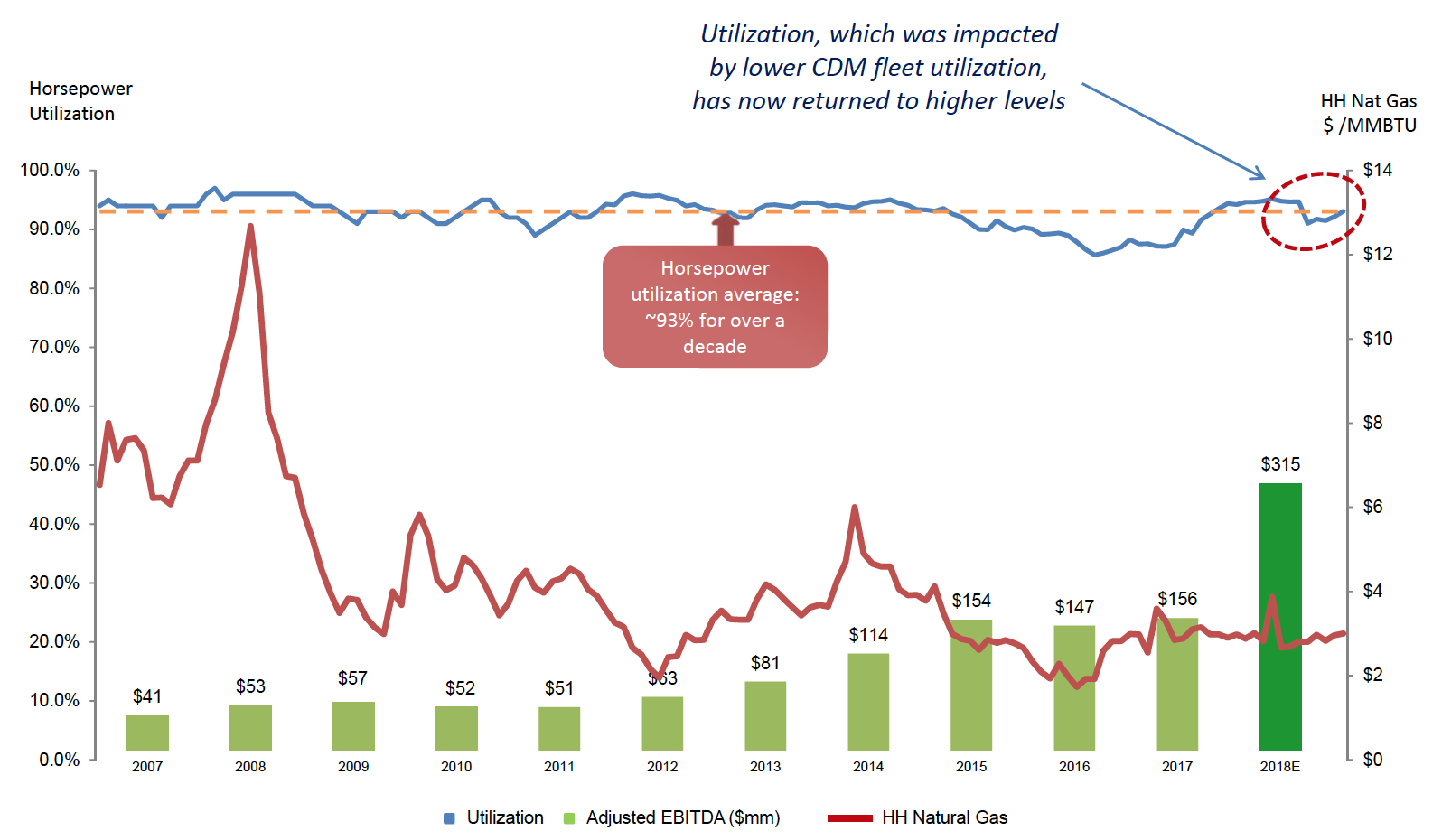
Although you wouldn’t know it from its current low price, which is near its 52-week low, USAC is in a good place now – demand for its large horsepower units is robust, and the major acquisition it made of the assets of CDM in early 2018 put it into a dominant position in its industry.
Management referenced this on the recent Q3 ’18 earnings call:
“The overall market for compression services remains very strong, driven by solid natural gas fundamentals and the continually midstream infrastructure buildup, which does not just combine to one region, but rather it’s taking place across the country in areas which we operate. We continue to take advantage of the strong market to push through rate increases while prudently investing capital in the business. Our utilization metrics demonstrate the current strength of the market and we expect continued strength throughout 2019, based on the current visibility for compression services demand.”
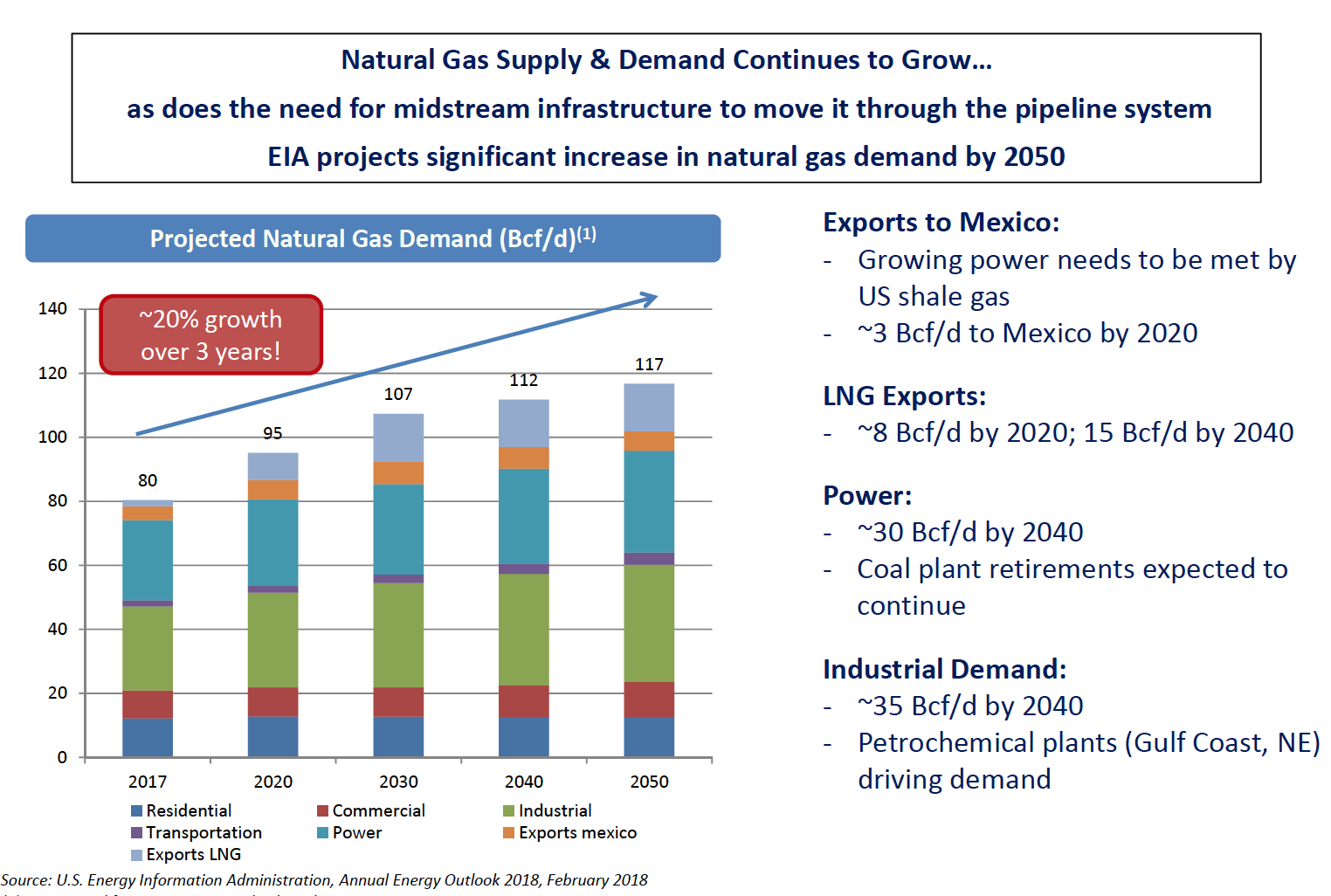
Natural gas has multiple drivers – increasing utilization as a replacement for coal at power plants, LNG exports, exports to Mexico, and demand as a feedstock for petrochemical companies, which continue to ramp up their presence in the US, in order to take advantage of larger natural gas supplies:
(Source: USAC site)
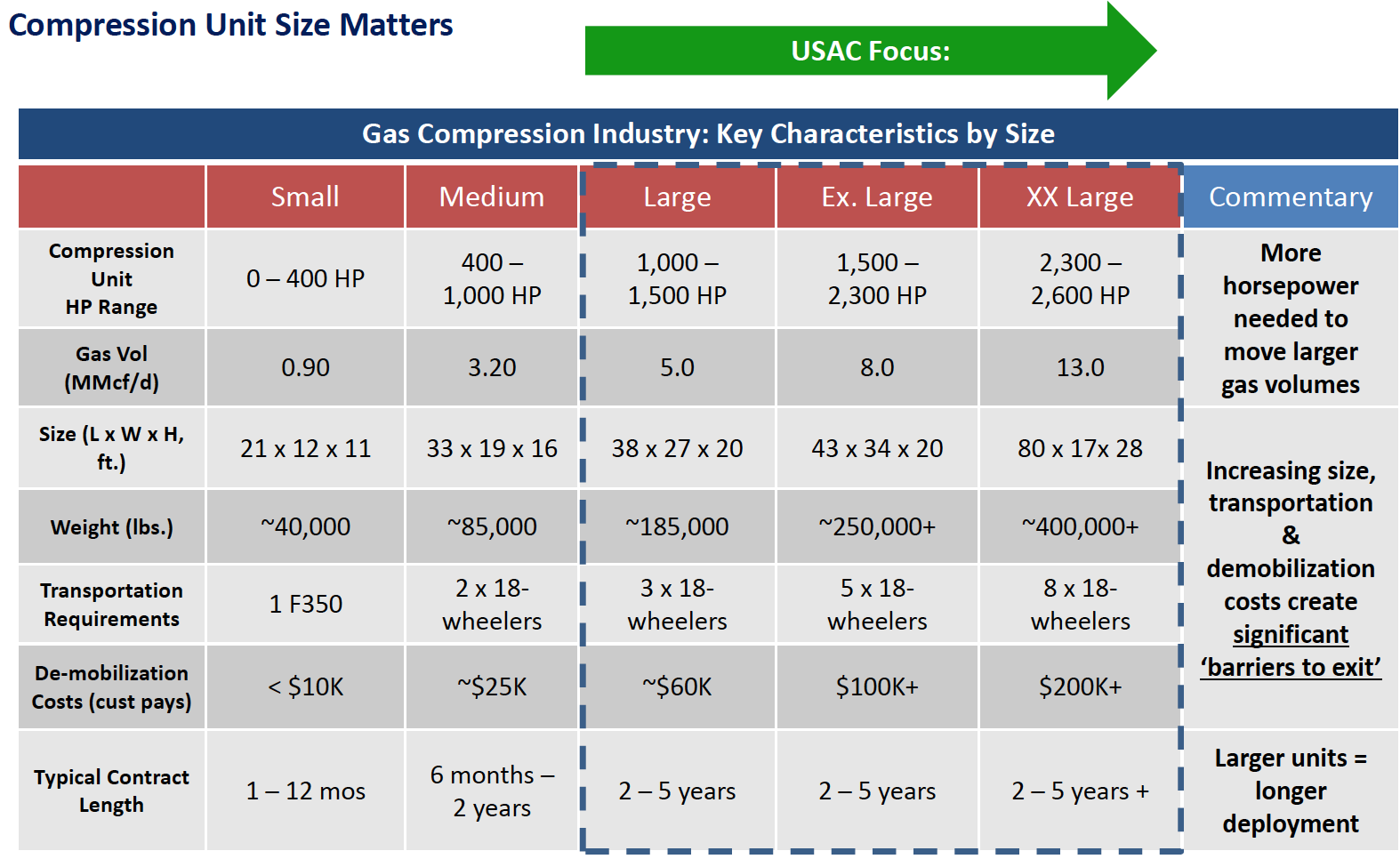
Many have posed the age-old question, “Does size matter?” with advocates on both sides of the argument.
However, when it comes to the scintillating world of compression, size does matter, and here’s where USAC has a distinct advantage over its competitors. The trend is toward outsourcing, particularly for large equipment, which tends to be “sticky” – it’s expensive for a customer to demobilize this type of equipment, ($60K – $200K plus), which promotes longer contracts and increasing prices for USAC.
“The market for large horsepower equipment has remained very tight as we’ve experienced throughout the entire year. Demand continues to be especially strong for the very largest horsepower categories in which USA Compression specializes.”
“Compression – the way forward continuing to outsource actually is trending to accelerate. So, I think you’re actually in a very unique time right now that you’ve got limitations on access to capital, you’ve got limitations on access to people and you have limitations on access to new equipment. So, all of those three things together can provide for a perfect storm which we think plays well to our strength of large horsepower infrastructure equipment and will allow us to re-price our book upward over time.”
“We’re in the equivalent of a seller’s market right now where there is a lot of demand and not a lot of supply.” (Source: Q3 call)
(Source: USAC site)
Looking forward, USAC should be able to capitalize on a better pricing environment: “When we look at the spot pricing on the new units we’re deploying, 120,000 some odd horsepower for next year, these are extremely attractive new unit economics, effectively five-year or less cash on cash type of payouts, low 20s, IRR on an levered type of basis.” (Source: Q3 ’18 call)
Distributions:
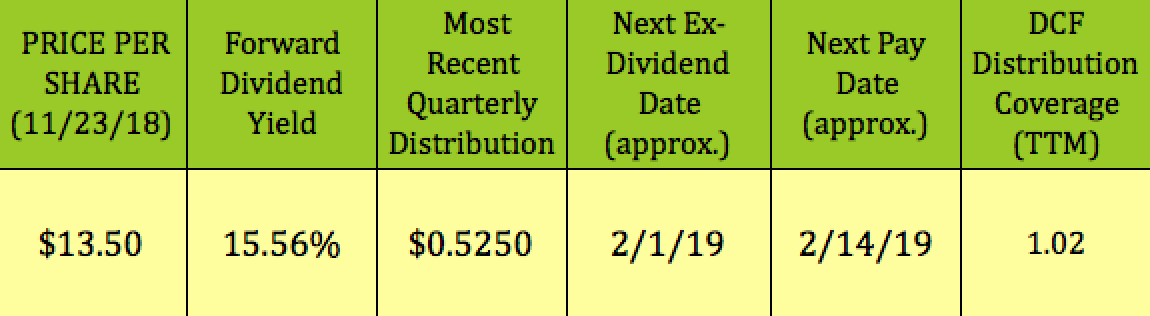
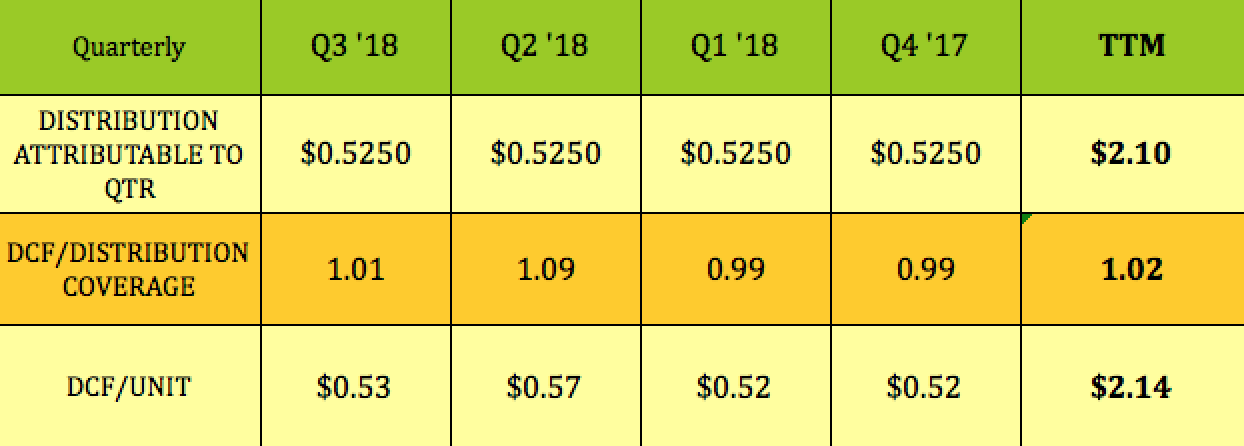
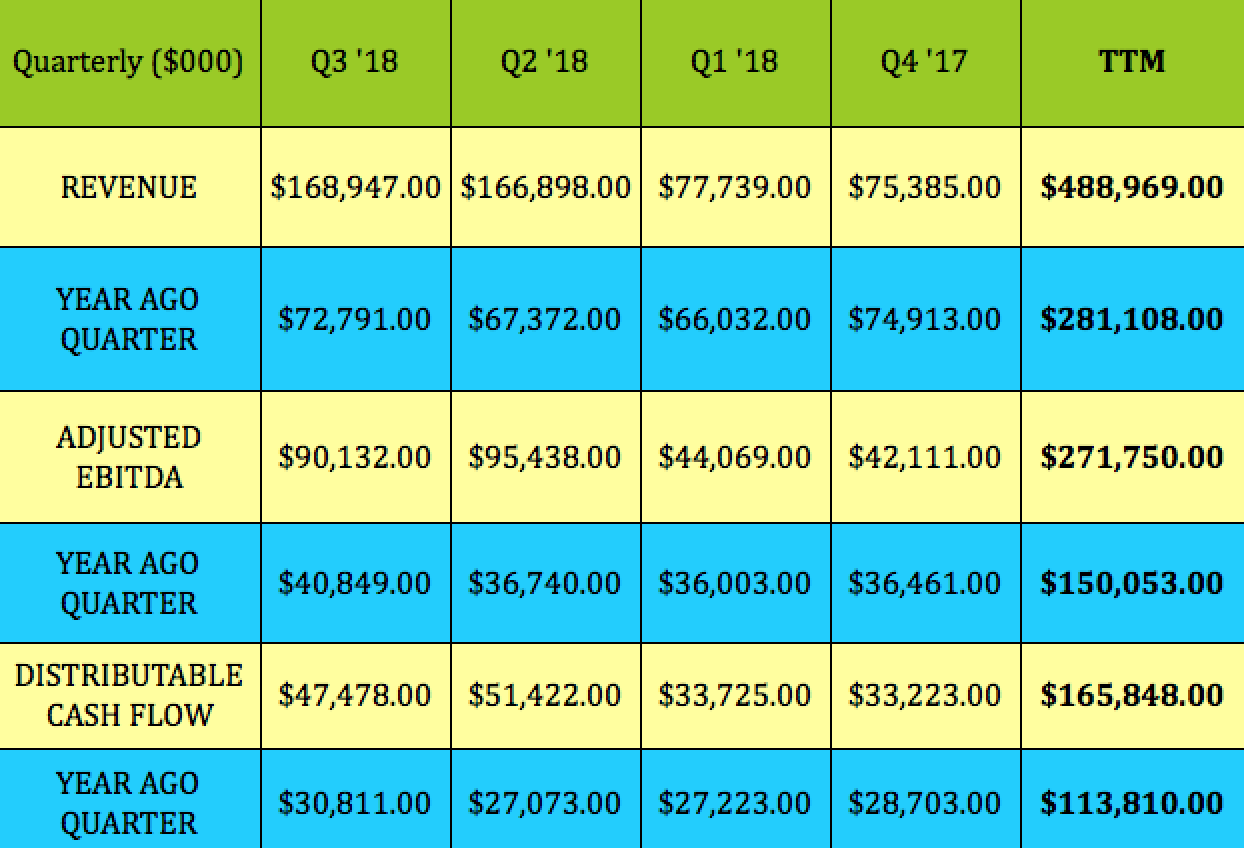
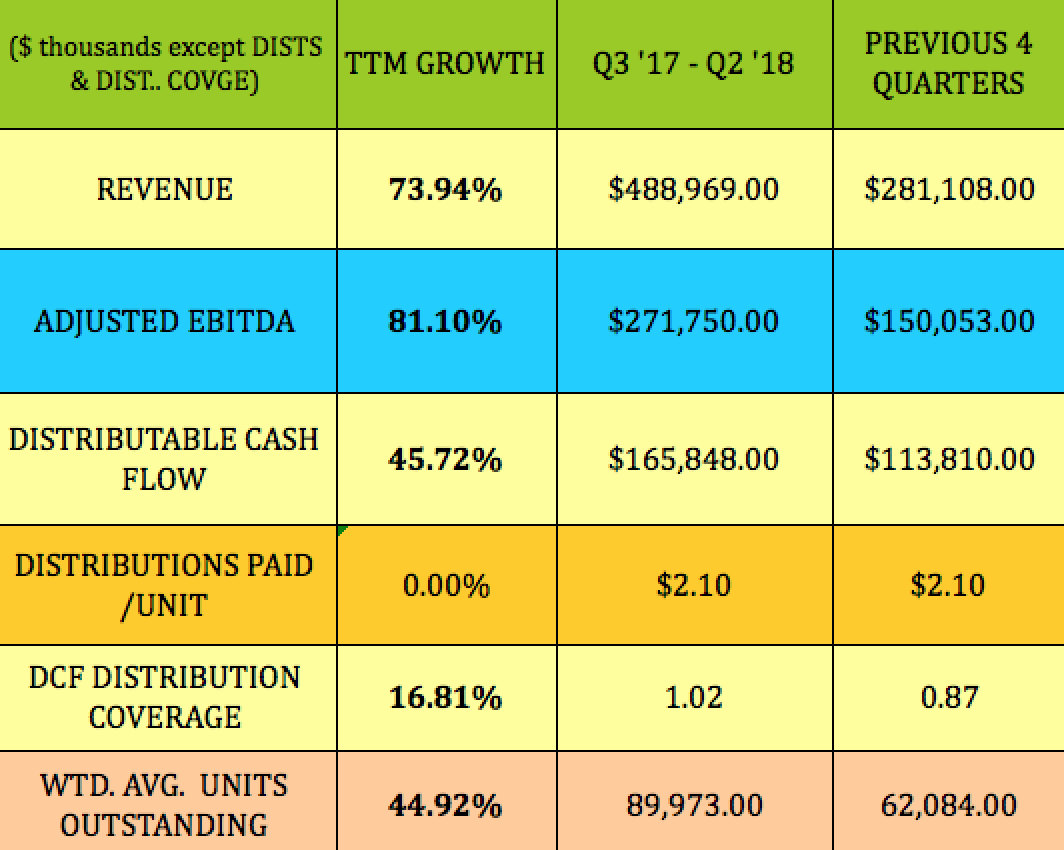
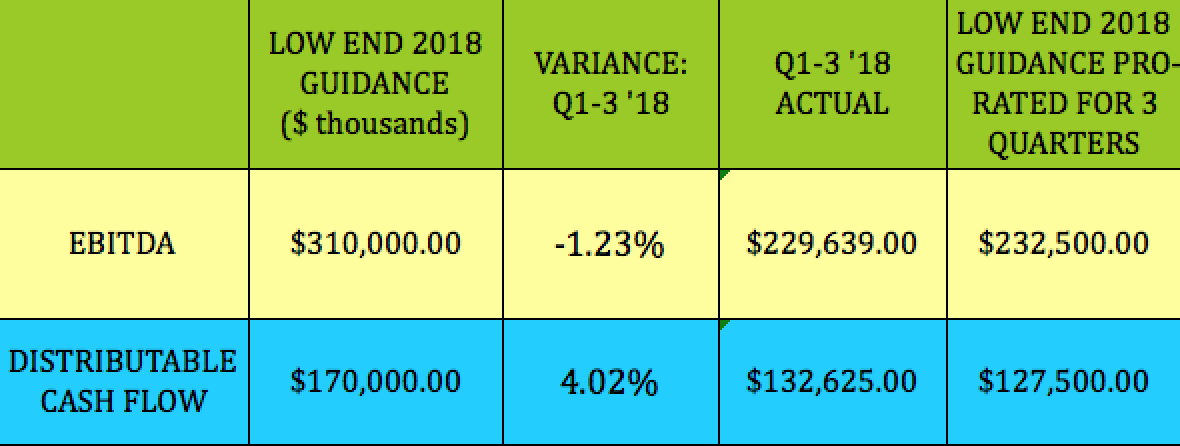
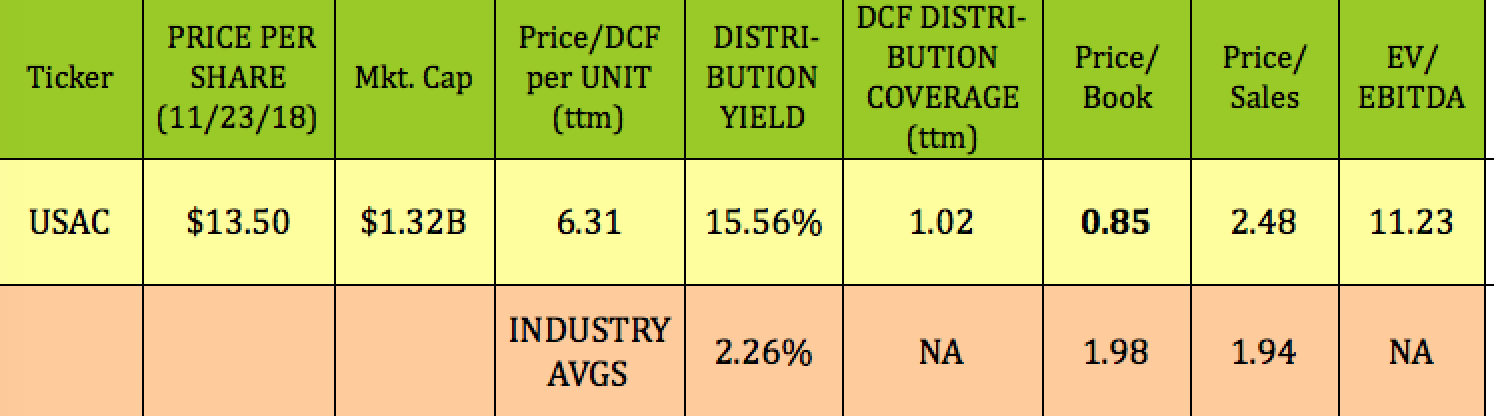
USAC’s next distribution should have an ex-dividend date sometime in early February. It pays in the usual Feb/May/Aug/Nov LP cycle for LPs, and issues a K-1 at tax time. At a $13.50 price/unit, USAC yields 15.56%, with trailing coverage of 1.02X.
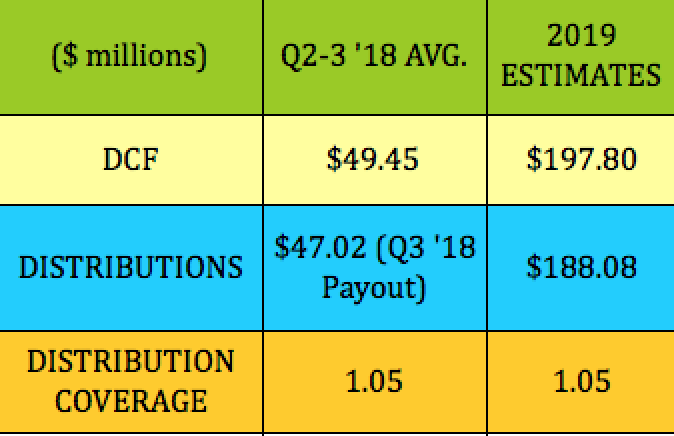
DCF coverage was just 1.01X in Q3 ’18. However, moving forward, management sees additional cost savings synergies from the CDM deal kicking in for 2019, as it finalizes the transition. The entire 900 employees of the company are now using the same customer, contract and asset data systems. This should improve coverage going forward, in addition to forward price increases.
No More IDR’s:
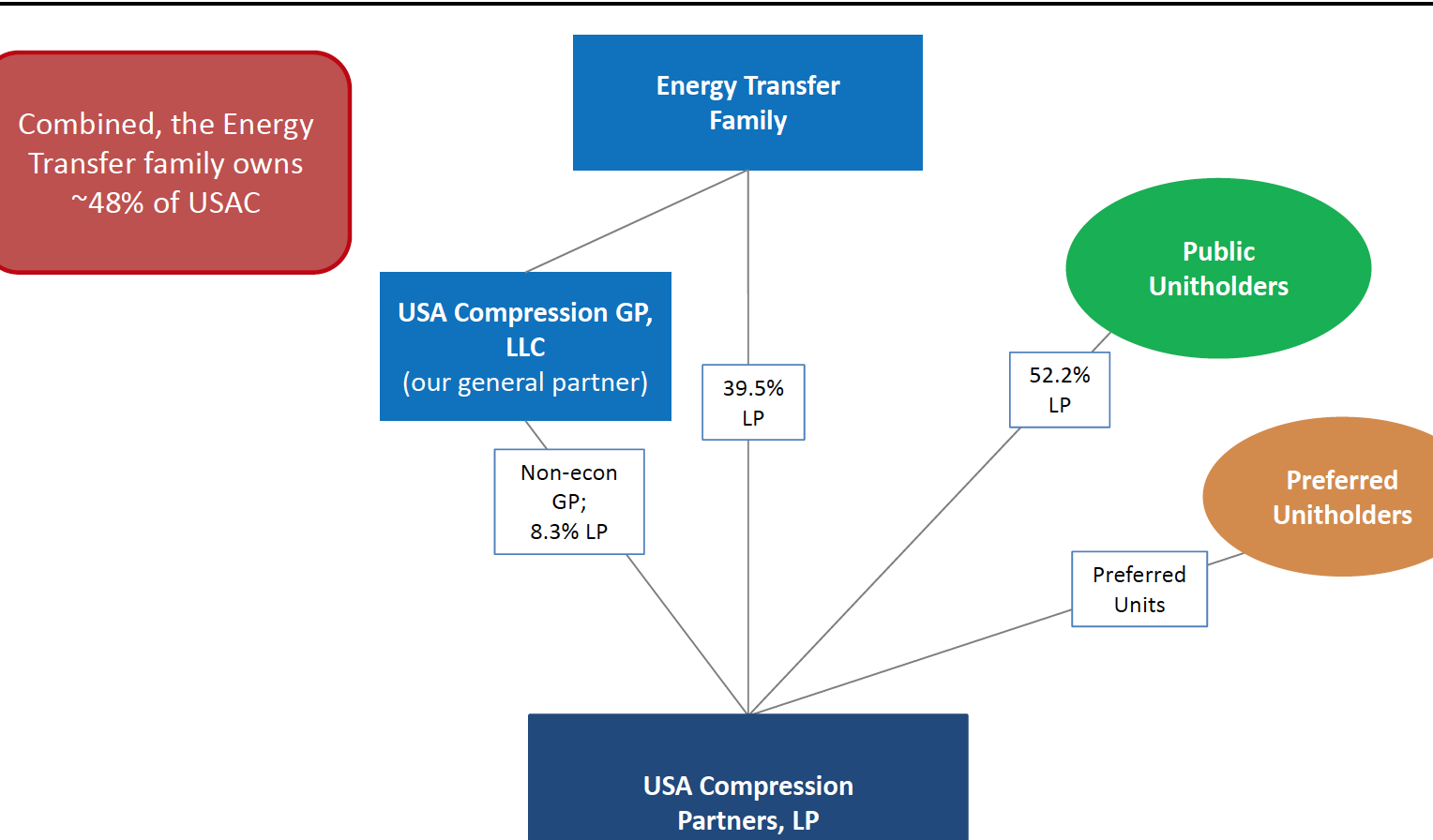
USAC closed on the CDM deal on 4/2/18. CDM was the compression services arm of Energy Transfer Partners LP, and Energy Transfer Equities, which merged into Energy Transfer LP (ET). CMD was valued at ~ $1.8B.
This deal included the following:1. The contribution of ETP’s subsidiaries, CDM Resource Management LLC and CDM Environmental & Technical Services LLC, to USAC.2. The cancellation of the incentive distribution rights in USAC.3. The conversion of the general partner interest in USAC into a non-economic general partner interest. As part of the transaction, ETE acquired the ownership interests in the general partner of USAC, and approximately 12.5 million USAC common units from USA Compression Holdings.
(Source: USAC site)
Earnings:
This table illustrates the impact that the CDM deal has had on USAC’s operations. It was transformative, ramping up revenue and EBITDA by well over 100% and DCF by over 54% in Q3 ’18, while Q2 ’18 saw even larger increases.
USAC had a larger than normal number of legacy CDM field technicians after the CDM deal closed, and also used outside parties to perform routine maintenance on some compression units, which was much more expensive than using internal personnel. It took a while to find the right caliber of technicians, due to a strong marketplace environment, but they’ve fixed the situation, and upgraded their staff talent level.
USAC’s coverage has improved dramatically over the past four quarters, rising from a sub-par .87x (when the GP was relinquishing IDR rights to support the payouts, up to 1.09X in Q2 ’18, and averaging 1.02x over the past four quarters).
Looking forward to 2019, if we use an average of the post-CDM deal Q2 and Q3 2018 DCF figures of $47.5M and $51.4M, respectively, that gives us an average DCF of ~$49.45M/quarter.
We compared and extrapolated that $49.45M DCF average to the Q3 ’18 total cash distributions of $47.02M, which were higher than the Q2 ’18 total of $43.5M.
If USAC’s DCF and total distributions stay flat, we should see 1.05X coverage in 2019. This is without the benefit any cost savings, or additional revenues from price hikes.
Fleet Utilization:
Fleet horsepower was over 3.6M, as of 9/30/18, an increase of more than 53,000 horsepower vs. Q2 ’18. Active horsepower increased 61,000 to over 3.2M, up ~2% over Q2 2018.
Another positive is that management has been able to redeploy ~353,000 horsepower of idle horsepower from the combined fleets at nominal additional capex costs. (CDM’s fleet had a lower utilization rate.) Most of its idle equipment is in the small horsepower category – long before the CDM deal, management had been shifting USAC’s emphasis toward large horsepower equipment.
USAC has had a very stable fleet utilization rate of ~93% for more than a decade:
(Source: USAC site)
Guidance vs. Performance:
Management narrowed its full-year 2018 adjusted EBITDA guidance range to $310 – $320M, and its 2018 DCF guidance range to $170m – $180M.
We pro-rated this 2018 guidance to three quarters to get an idea of USAC’s actual Q1 ‘3 ’18 results compare to the guidance. So far, EBITDA looks roughly in line with the low end of 2018 guidance, while DCF is ~4% above it.
Risks:
Natural Gas downturn – If there’s another protracted downturn in the energy patch, this could lead to a cutback in rigs, and potential demand for compression services, even the large units, which are in tight demand now.
Unlike crude oil, which has had a rough go of it in 2018, natural gas futures are up 34% over the past month, and 46% year to date in 2018. However, producers need compression to get their product out of the ground, which gives USAC a cushion in energy cycles, as its fleet utilization has had a strong, long term record of 93% utilization.
IRA Holders – Holding an LP in an IRA may result in tax complications for IRA holders due to UBTI. You’ll also get more tax deferral advantages from investing in USAC in a taxable account. You should consult your accountant about these aspects of investing in LPs.
Valuations:
At $13.50, USAC is less than 5% above its 52-week lows – its price hasn’t been this low since April 2016. It’s also selling at .85x of book value, and its price/DCF is one of the lower valuations we’ve seen recently.
Analyst’s Price Targets:
That $13.50 price puts it nearly 26% below analysts’ lowest price target of $17.00, almost 44% below the $19.43 average price target.
Insiders Are Buying:
Management just upped its skin in the game last week – they bought 45,000 units at a price range of $13.40 to $13.90.
(Source: finviz)
Financials:
Due to negative net income, which includes heavy non-cash depreciation and amortization charges, USAC has negative ROA and ROE valuations.
The interest coverage factor of just .69X looks poor, when compared to the 1.45X average, but, again that includes a great deal of non-cash depreciation and amortization charges.
USAC’s EBITDA/Interest coverage factor for Q1-3 ’18 was 4.49X.
Debt and Liquidity:
“As of September 30, 2018, the Partnership had outstanding borrowings under the revolving credit facility of $1 billion, $578.2 million of borrowing base availability and, subject to compliance with the applicable financial covenants, available borrowing capacity of $309.7 million. As of September 30, 2018, the outstanding aggregate principal amount of the Partnership’s 6.875% senior notes was $725 million.”
(Source: USAC site)
USAC’s Credit Agreement has an aggregate commitment of $1.6B, with a further potential increase of $400M, and has a maturity date of April 2, 2023.
Its 6.875% senior notes Senior Notes mature on April 1, 2026.
Options:
We have options picks for USAC in our Double Dividend Stocks service, which we can’t divulge here, but you can see trade details for over 25 other option-selling trades in our Covered Calls Table and Cash Secured Puts Table.
Summary:
We rate USAC a long-term buy. Demand for its natural gas compression services isn’t going away any time soon, just the opposite. USAC has a strong position in its niche industry, and is well-positioned to benefit from increasing demand for large-scale horsepower compression.
Disclaimer: This article was written for informational purposes only, and is not intended as personal investment advice. Please practice due diligence before investing in any investment vehicle mentioned in this article.
CLARIFICATION: We have two investing services. Our legacy service, DoubleDividendStocks.com, has focused on selling options on dividend stocks since 2009.
Disclosure:I am/we are long USAC.
I wrote this article myself, and it expresses my own opinions. I am not receiving compensation for it (other than from Seeking Alpha). I have no business relationship with any company whose stock is mentioned in this article.
NEW YORK (Reuters) – Shoppers across the United States snapped up deep discounts on toys, clothing and electronics both online and at stores on Black Friday, giving retailers a strong start to their make-or-break holiday season.
A healthy economy and rising wages gave people the confidence to splash out on retailers’ annual raft of bargains.
“The prices today are very good,” said Jose Manuel Cruz Hernandez, 59, who hit the Del Amo Fashion Center in Torrance, California, with his sister Paulina Cruz, 66, who comes every year from Mexico City to shop.
The pair spent $120 on princess dolls and other toys at the Walt Disney Co store, where items were 20 percent off. They spent a similar amount at Gap Inc, where items were discounted by about 55 percent.
Cruz Hernandez, a foreman at an aerospace firm, said he was comfortable with the U.S. economy and his own finances and plans to spend another $1,000 on holiday gifts – about the same as last year.
A similar story played out online, where shoppers spent $643 million by 10 a.m. ET, up 28 percent from a year ago, according to Adobe Analytics, which tracks transactions at most of the top U.S. online retailers. Smartphone sales in particular contributed to gains.
Foot traffic looked healthy at stores offering discounts, although detailed numbers on brick-and-mortar holiday sales will not be available for several days.
“Overall, Black Friday doesn’t have the sense of urgency as in the past and feels more like a busy regular weekend day in many of the stores,” said Dana Telsey at Telsey Advisory Group.
“Many of the promotions were available for the past couple of weeks,” Telsey said. “We haven’t noticed desperation from any retailer.”
Shares of Macy’s Inc, Kohl’s Corp, and Target Corp all closed down on Friday and weighed on the broader S&P 500 retailing index, which closed down 0.56 percent.
Investors are concerned retail sales growth may have peaked in the second quarter and business will slow down as comparisons get tougher, said Brian Yarbrough, retail analyst with Edward Jones.
Victoria’s Secret owner L Brands, Walmart Inc and American Eagle Outfitters rose. J.C. Penney Co Inc ended flat and Amazon.com Inc closed slightly lower.
The overall stock market finished a shortened session with losses.
STRONG ONLINE SALES
Early numbers showed overall retail sales, both in stores and online, were in line with expectations, according to Mastercard Inc’s SpendingPulse retail report. The firm expects overall Black Friday sales to top $23 billion this year, up from $21 billion last year.
Mastercard combines sales activity in its payments network with estimates of cash and other payment forms. It said cold weather in the eastern United States and wet weather in the west may be pushing more consumers online.
Online spending is on track to hit $6.4 billion on Friday, Adobe said. Online sales on Thanksgiving Day were up 28 percent at $3.7 billion.
The National Retail Federation forecast U.S. holiday retail sales in November and December will increase between 4.3 and 4.8 percent over 2017 for a total of $717.45 billion to $720.89 billion. That compares with an average annual increase of 3.9 percent over the past five years.
About 38 percent of American consumers plan to shop on Black Friday, a Reuters/Ipsos poll showed last week.
People shop during the Black Friday sales shopping event at Roosevelt Field Mall in Garden City, New York, U.S., November 23, 2018. REUTERS/Shannon Stapleton
Very cold weather in the U.S. Northeast may have kept some shoppers at home, although industry analysts also reported added demand for coats and other warm clothing. An Athleta clothing store in Tysons, Virginia, provided hot chocolate with marshmallows to women in line for the dressing room.
DEAL FRENZY
Shoppers picked up big-ticket items such as TVs, Apple Inc iPads and Watches at Target, while phones, toys, gaming consoles and cookware were top sellers at Walmart Inc.
Many shoppers sought out air fryers, which do not use oil to deep fry food and Instant Pots. Kohl’s Chief Executive Michelle Gass told CNBC the company was selling 60 Instant Pots per minute online on Thanksgiving Day.
While most retailers have not changed their deals and discounts year-over-year, many have moved their start dates earlier and offered more teasers, according to deal site RetailMeNot.
The deepest discounts in apparel and accessories were offered by Michael Kors, which ran a 60 percent discount sale; Gap, which offered 50 percent off site-wide; and Nordstrom, which gave away up to 60 percent on merchandise.
Other deals included:
* An H&M store in Manhattan offered 30 percent off everything in-store and online.
* Macy’s in Herald Square, Manhattan, sold a Coach designer wallet, originally $225, for $53. Coach bags there, originally $259, were half off.
* Midtown Comics was taking 25 percent off everything at its three Manhattan locations until noon.
* An Eddie Bauer in Chicago offered 50 percent off all items.
* At a Chicago-area Pandora, which sells popular charm bracelets that can cost up to $1,000, jewelry was 35 percent off before 10 a.m. and 25 percent off for the remainder of the day.
* J Crew clothing was 50 percent off. Its site experienced some technical difficulties.
* Walmart was selling a Google Home mini for $99.
REPLACING A TOY STORE
Many retailers, reacting to the bankruptcy of the Toys ‘R’ Us chain, are catering to parents.
Target said in October it planned to dedicate nearly a quarter of a million square feet of new space to its toy business across 500 of its stores.
“Toys ‘R’ Us had better quality for toys,” said Ashley Drew, 29, shopping for her 5-year-old daughter at a Los Angeles-area Walmart, next door to the empty shell of a Toys ‘R’ Us store.
Department store JC Penney, known for its mid-priced apparel, has also made a push into toys.
Slideshow (13 Images)
Carolyn Pertette from Wilkinsburg, Pennsylvania, shopped in the early morning at the Waterfront Mall in Pittsburgh.
“I’m concerned about where I’m going to get toys,” she said.
Additional reporting by Shannon Stapleton in Long Island; Lewis Krauskopf, Melissa Fares, Jennifer Ablan and Anna Irrera in New York; Lisa Baertlein in Los Angeles; Richa Naidu in Chicago; Margaret Rice in Tysons, Virginia; and Siddharth Cavale in Bengaluru; Writing by Nick Zieminski; editing by Patrick Graham, Saumyadeb Chakrabarty and Bill Rigby
This research report was jointly produced with Samuel Smith, co-author of High Yield Landlord.
Brookfield Property Partners (BPY) offers investors a unique opportunity to own world-class properties at a steep 40% discount to NAV alongside an attractive 7% dividend yield. Furthermore, its access to plentiful, low-cost capital and global markets – thanks to the vested interest of its parent Brookfield Asset Management (BAM) – gives it an attractive long-term growth profile. As a result, we are adding BPY to our core portfolio, giving our portfolio the added benefit of exposure to high quality office real estate.
Business Model
BPY was formed in 2013 as one of BAM’s limited partnerships. While this means it issues a K-1 (as a Bermuda-based LP) – a deal-breaker for some investors – there are two reasons that Brookfield Property appeals to those that typically reject such investments. First, BPY’s assets are also structured as limited partnerships. Therefore, it does not generate UBTI, making the units suitable for inclusion in a retirement account. Second, Brookfield recently started offering a REIT alternative, known as Brookfield Property REIT (BPR) to eliminate the K-1 if desired. They are both set to be economically equivalent and offer identical distributions/dividends both in terms of quantity and schedule.
One of the biggest competitive advantages that BPY/BPR enjoys is that BAM owns 52% of BPY’s units and therefore, indirectly over 30% of BPR’s shares. With such a huge vested interest, BAM – as one of the world’s oldest, largest, and most successful real asset managers – provides BPY/BPR with access to a never-ending supply of lucrative deals through its enormous global network of business and government connections, strong management, and the security and cost of capital advantage that its enormous liquidity and A-rated balance sheet brings.
Alongside investments from its parent, BPY finances its investments by raising funds through selling debt and units in the public markets. It then uses these funds to buy equity stakes in various investment funds as well as individual assets fed to it through its Brookfield network. The vast majority of its focus is on high-quality office and retail (Class A malls and shopping centers) real estate, while it also invests in opportunistic diversification opportunities as they present themselves including multifamily, student housing, hospitality, self-storage, and industrial properties. Through acquiring quality assets at what it believes to be significant discounts in combination with its operational and value-add expertise, BPY aims to generate long-term returns of 12-15% while growing its distribution at a robust 5-8% annual rate. Management also enhances returns by routinely selling assets at rich valuations and recycling the capital at higher cap rates, which it can then apply its value-add/operational expertise too to unlock further value.
Another way in which management expects to drive superior returns over the long term is through its geographic and asset class diversification. By maintaining numerous options, BPY gives itself the ability to deploy capital at the greatest value, regardless of the market conditions in any one of its markets. It also tends to level overall operating results, similar to how a diversified stock portfolio experiences less volatility over time. Furthermore, management leverages its Brookfield connections in order to give it informational, operational, and bargaining advantages, enabling it to get superior values on its acquisitions and dispositions while also enhancing its value-add and deal flow operations.
Portfolio
BPY’s recent portfolio holdings include office, retail, multifamily, logistics, hospitality, self-storage, and student housing properties.
Office
BPY owns, develops, and manages 288 office properties totaling approximately 138 million square feet in premier cities in the major economic powerhouses of the world, including the U.S., Europe, Canada, Australia, Brazil, India, and South Korea. This global network works alongside the Brookfield connection to give them strong pricing power as a major landlord partner for some of the very safest investment grade tenants, including major international corporations and government agencies of top Western economies (i.e., U.S., Canada, U.K., and Germany). As a result, their office properties enjoy consistently strong occupancy and NOI growth (driven in part by ~10% long-term leasing spreads) and are, therefore, considered to be very safe relative to most other office REITs.
Some of their assets include:
Brookfield Place New York, U.S.
This state-of-the-art multipurpose property boasts a diverse tenant base including restaurant, retail, and office space. It experiences ongoing strong demand from businesses and customers alike as a premier live-work-play destination in Lower Manhattan.
BPY owns premier office and retail assets on the Canary Wharf estate in London through a joint venture, including ~7 million square feet of office space, over 800,000 square feet of retail space, and an office and residential development pipeline of over 3,000,000 square feet.
As an iconic mixed-use complex in the center of historic Berlin, management is investing €100 million to unlock its full potential by renovating and repositioning the 3 million square feet estate as an attractive location for office, retail and residential tenants.
A 5.4-million-square-foot premier, mixed-use complex in Seoul, South Korea, consisting of three office buildings, a 400,000-square-foot mall, and a five-star Conrad hotel, this property gives Brookfield a strong presence in the heart of Seoul and the ability to attract and retain strong tenants.
This property is a 4 million square feet, mixed-use complex in Shanghai’s central business district and Hongqiao transportation hub. The property’s owner partnered with Brookfield to leverage their expertise in completing some of the development and leasing the buildings. The partnership has already sold two towers at prices that outperformed initial projections.
A 10-million-square-foot, Class A office portfolio within India’s Special Economic Zones (“SEZ”) alongside a partially constructed, 6 million square feet development portfolio, Brookfield views this initial foray as laying the groundwork for significant expansion in the country’s marketplace.
After acquiring two of Olympia & York’s publicly traded entities, Brookfield improved its presence in key markets by renovating in adding value to core properties in the 11 million square feet office portfolio. The non-core properties have since been sold off.
Manhattan West, U.S.
A 7 million square feet, mixed-use development at the gateway of the Hudson Yards District, it is one of New York’s largest and most state-of-the-art development projects. When completed, it will include three office towers, 844 apartments and 200,000 square feet of retail space, with strong appeal to the nearby business district as a premier work-live-play development.
This portfolio reflects a 2006 privatization of Trizec Properties, an office REIT with a presence in numerous major U.S. cities. Through the acquisition, Brookfield was able to unlock value in the portfolio by selling off non-core properties and leveraging their superior operating expertise and tenant network to grow NOI in the core properties.
Multifamily
As one of the largest owners and managers of residential apartment properties in the United States (over 25,000 multifamily units), Brookfield focuses on high growth markets and then leverages a fully integrated national multifamily services platform providing development, construction, renovation, asset and property management, and acquisition and disposition services. Brookfield also adds value through development work, with over 3 million square feet of property under various stages of construction in the U.S. and the U.K.
Associated Estates Realty Corporation, U.S.
After acquiring the company, Brookfield used its capital and expertise to grow the portfolio by ~13,000 units across 10 states while also renovating existing properties to add value.
Manhattan Multifamily, U.S.
A 4,000-unit portfolio in New York City, the property enjoys its prime location near Columbia University’s Manhattanville campus, the Second Avenue subway expansion, and Cornell University’s tech campus in Roosevelt Island. Brookfield has invested significantly in extensive renovations, technology upgrades, and a modernization of the energy systems, which have combined to yield a very attractive return on investment through rental growth and reduced costs.
Brookfield has built a high-quality retail portfolio in the U.S., Europe, Brazil, and Asia. Some of their world-class assets include the famous Ala Moana Center (Honolulu), Fashion Show (Las Vegas), Tysons Galleria (Washington D.C.), Glendale Galleria (Los Angeles) and Water Tower Place (Chicago) as well as urban mixed-use retail districts in New York, Shanghai, London, and Berlin. With 100 of the top 500 malls in the U.S., these properties are far from dead and dying as they are landmarks, city centers, and tourist attractions, drawing from among the best tenants with strong pricing power ( high-teens leasing spreads over the past year, leading other industry peers). Furthermore, no single tenant accounts for even 4% of total rent and the average remaining lease term is ~6.5 years, giving them significant diversification and cash flow visibility.
GGP Inc., U.S.
The GGP acquisition gives Brookfield access to a large portfolio of solid retail real estate across the United States. BPY believes it can unlock considerable value by leveraging its business network, operational expertise, superior access to low-cost capital, and development acumen by repositioning and repurposing several of the properties with the long-term in view. It was willing to buy GGP shares at a premium because it believed it could drive long-term value from the properties in a way that GGP could not.
Brookfield owns ~34 million square feet of high-quality distribution facilities and continues to grow its portfolio as one of the nation’s largest logistics developers. The company uses its large network of warehouses and global tenant base to secure attractive long-term leases and high occupancy on its properties.
IDI Logistics, U.S.
Brookfield built this firm to serve as an owner, developer, and operator of warehouses and distribution facilities, selling its European business for a highly impressive IRR of 47% while continuing to own the U.S. business.
Brookfield also owns and manages full-service hotels and leisure-style hospitality assets in high-barrier-to-entry markets across North America, the U.K., and Australia. The company pursues a strict value-add approach to these properties.
Center Parcs, U.K.
An operator of five short-break holiday destinations in the U.K. that generates stable, predictable cash flows. It enjoys a strong moat due to geographical and capital scale barriers to entry. Brookfield has capitalized on these strengths by investing heavily in growing the business.
The Diplomat Beach Resort, U.S.
As one of the few beachfront hotels with extensive conference facilities located between Miami and Fort Lauderdale, Brookfield has invested in renovating the resort and exploiting its unique positioning in the local market to carve out a niche moat.
A 3,000-room beachfront resort with a convention center, casino, golf course, waterpark, and 65 acres of developable land, Brookfield has added value by renovating the casino, guestrooms, and improving its food and beverage offerings.
This asset possesses numerous competitive advantages that give it significant pricing power and strong demand: it is located directly across from City Hall, it is one of the largest institutional-quality, full-service convention hotels in downtown Toronto, and it is in a market with positive growth fundamentals and high barriers to entry. The hotel itself is highly impressive: 1,372 rooms, approximately 121K SF of newly renovated meeting space, with a direct connection to Toronto’s PATH network via 44,000 square feet of retail space on the concourse level of the PATH system and along Queen Street. Management envisions making the property even more elite by executing a comprehensive renovation plan, improving amenities, enhancing the arrival experience, and repositioning the retail space.
Additional assets in their portfolio include U.K. student housing portfolio (45 properties with over 16,000 beds), 136 manufactured housing communities in the U.S., over 300 triple-net lease auto dealership properties in North America; and numerous self-storage properties in the U.S. (some of which it recently sold for a 46% IRR).
Valuation
BPY appears undervalued based on numerous metrics. First, BPY’s current NAV (IFRS accounting) per unit valuation is ~$30, meaning that unit-holders have the opportunity to purchase equity in its high-quality and well-diversified portfolio at a 40% discount. Management reaffirmed its conviction in its steep discount during its most recent earnings call by discussing the possibility of beginning to buy back a massive amount of units in the coming quarters.
Second, it offers a substantially higher yield relative to other publicly-traded premier office and mall operators including Simon (SPG), Taubman (TCO), Regency (REG), and Boston (BXP):
Furthermore, on top of its forward yield of ~7%, its plentiful access to low-cost capital and lucrative global deals through its sponsor combined with its value-add, operational, and pricing power competitive advantages give it a strong growth outlook. 2019 FFO projections put its current forward P/FFO multiple at a mere 9x. Its five-year average is over 10x and peers such as Simon trade at a P/FFO multiple of ~15x. Management forecasts that between organic, property-level NOI growth through value-add improvements and leasing spreads, development projects, profitable investment dispositions, and accretive acquisitions/unit buybacks, they should be able to grow FFO/unit (as well as distributions/unit) at a 5%-8% rate over the long term. However, given BPY’s recent large accretive investment in GGP, with a significant amount of additional projected accretive investment to be made in the GGP portfolio, management sees the upper end of that growth rate range being more accurate.
Even allowing for a significant margin of safety and assuming growth at the low-end of that guidance (5%-6% annual FFO/unit growth), BPY is still poised to deliver very healthy annualized returns of 11%-12% (according to the Gordon Growth valuation model). When considering the high-quality of the asset base and the deep resources of BPY’s parent, these returns are extremely attractive in a risk-adjusted context.
Risks
Given that the investment looks extremely attractive, why are units so cheap? First of all, many retail investors do not want to have to deal with the K-1 come tax time and BPR was just recently issued, so it may take a while for it to catch on with investors. Furthermore, the existence of the much larger publicly traded parent’s shares as well as numerous opportunistic investment funds within the Brookfield family provides significant competition for institutional dollars. Finally, as an LP, BPY units are not included in most real estate/REIT ETFs, mutual funds, and CEFs due to their focus on REITs. These factors combine to keep demand down for units, helping them to remain at a discount.
An additional factor tempering demand for units was the recent GGP acquisition. Due to the numerous uncertainties surrounding the details of the deal and the market’s general wariness of U.S. retail real estate, many investors preferred to steer clear. However, we believe that with the deal in the rear view mirror and the dust settling, investors will begin to overcome their initial reservations as they see the tremendous value proposition in these units. Already in just the past several weeks since the deal was completed, BPY’s units have been outperforming retail REIT peers.
The most significant risks in our mind stem from BPY’s high leverage as well as its exposure to international currency and geopolitical risks. Debt-to-EBITDA is ~13x, clearly a very elevated leverage level. However, there are five significant caveats that keep us highly optimistic about the safety of this investment.
First, as previously mentioned A-rated parent BAM has an enormous amount of skin in the game here, and currently enjoys a record amount of liquidity. As a result, they will likely do everything in their power to ensure that BPY sustains its investment-grade credit rating (currently BBB) and enjoys the liquidity necessary to continue generating strong shareholder returns.
Second, BPY’s portfolio is very high quality. Given its premier office and retail portfolios and diversification across geographies, tenants, and property sectors, cash-flows should remain quite steady over time, making servicing their debt very feasible. Should a recession occur, some of its portfolio (in particular some of the lower quality Class-A malls from the GGP portfolio) will likely experience declining occupancy and pricing power? However, management is planning to sell some of the non-core GGP properties and redevelop/significantly upgrade the others, thereby mitigating some of this risk.
Third, BPY structures its debt in a highly conservative manner. 76% of its debt is non-recourse asset-level debt, meaning that its corporate-level debt is extremely low. It also means that if any of its properties underperform to the point of failing to service their share of the debt, they can simply give them to the lender and remove the burden from the rest of their portfolio.
Fourth, management is dedicated to deleveraging, with an emphasis on paying down its already minor corporate debt. It forecasts bringing leverage down to 11x within the next year and a half primarily through debt pay-down and then further deleveraging over the long-term as development projects come online
Finally, geopolitical/macroeconomic risk is mitigated by the fact that most of the economies in which Brookfield operates continue to be strong/strengthening, liquidity remains plentiful (giving them ample time to deleverage), interest rates remain low (reducing the cost of carrying/refinancing a lot of debt) and the flattening yield curve portends low upside for further rate increases, leasing contracts typically have inflation increases built in to them, only 26% of assets are generating rent in foreign currencies, and BPY employs currency hedges to further reduce this exposure.
In summary, BPY – like all investments – is certainly not risk-free and we certainly would prefer to see them reduce their leverage by a considerable amount. However, we view that enough risk mitigation measures are being implemented to prevent this from being a deal breaker, especially when considering the significant value embedded in the units.
Bottom Line
BPY has one of the most enviable property portfolios in the world, with the financial, operational, and networking backing of the Brookfield family giving it plenty of options to continue growing and improving its portfolio. Despite these obvious advantages, units remain cheap due to competing investment alternatives and concerns about over-exposure to U.S. retail real estate and overleveraging as interest rates rise. However, given the risk mitigation techniques in place and the high-quality, diversified assets underpinning the partnership, we believe that BPY remains a fairly safe investment with very strong total return potential. Finally, its 7% distribution combined with its mid-to-high single digit annual growth potential make it a nice complement to our yield-focused portfolio.
If you enjoyed this article, scroll up and click on the “Follow” button next to my name and choose “email alerts” to not miss my future articles on other REIT opportunities.
High Yield Landlord is one of the largest and fastest-growing communities of real estate investors on Seeking Alpha. This holiday season, we want to show our appreciation to our loyal readers. To say thank you, we are offering you a special discount. Subscribe now and SAVE $100. It is our best offer yet. Only valid for first 20 members.
Our high yielding real estate portfolio is just one click away. Take advantage of our Black Friday Sale with a two-week free trial. For more information click HERE.
Disclosure:I am/we are long BPY (INDIRECTLY THROUGH BPR).
I wrote this article myself, and it expresses my own opinions. I am not receiving compensation for it (other than from Seeking Alpha). I have no business relationship with any company whose stock is mentioned in this article.
You don’t have to change your entire morning or suddenly start training for a marathon when you wake up to create a morning that will nourish the rest of your day. These three simple morning habits are a great place to start if you want to create a morning routine that will enhance your productivity.
1. Get an early start to the day.
As we all know, the early bird gets the worm. Getting an early start to your day allows you to begin your day with the freedom (and time) to own your morning. Instead of hitting the snooze button and running out the door to avoid being late, try waking up 30 or 40 minutes before you normally do.
Lauren Vanderkam’s book What the Most Successful People Do Before Breakfast shows that almost 50 percent of self-made millionaires start their mornings three hours before their day needs to begin and that 90 percent of all executives prefer to be early rises and wake up before 6A.M. on workdays.
Waking up early gives you time to get what you want to be done before heading into work. Take this time to make a healthy breakfast, read, meditate, or to do the remaining productive boosting habits on this list.
2. Say your goals for the day out loud.
No matter how big or small your goal is for the day, week, or year it’s important to keep it at the front of your mind every single day. Creating a pathway to progress on your goals starts with acknowledging them.
Being an entrepreneur means having to put out a million little fires a day, while still building a company and pushing a product or service. Being in charge of clients, employees, marketing materials X, Y and Z can start to give you whiplash. This is why it’s especially important to state your goal and objective every morning. Staying grounded in this will help you on even your busiest of days.
Add a massive amount of productivity to your day by reciting your goals at the start of your day. Do so in a positive and affirmative way. Instead of saying “I want my company to earn X amount of revenue by X”, say “My company has a brilliant product, and we will earn X amount of revenue by X day.”. You should also do this with smaller, personal goals.
Visualize what you want your day to be like, and what aspects of your day will attribute to you getting closers to your goal. Give yourself reassuring affirmations that will stay with you throughout the day–no matter how hectic it gets.
3. Write a detailed to-do list.
Writing a to-do list every morning is a fantastic way of taking inventory of what you didn’t get accomplished the day before, and what you plan to get done today. Starting your day off by doing this every morning helps you set the tone for the day.
Use this list in conjunction with your schedule to keep you prepared for what needs to get done that day. Staying aware of what your day should consist of is the easiest way to stay on track. This will boost productivity by allowing you to prepare for your day within the hour you wake up.
ORLANDO, Fla. (Reuters) – The first flight of a SpaceX rocket tailored to fly astronauts to the International Space Station is set for liftoff from Kennedy Space Center in Florida on Jan. 7, NASA said on Wednesday.
FILE PHOTO: The top of a replica Crew Dragon spacecraft is show at SpaceX headquarters in Hawthorne, California, U.S. August 13, 2018. REUTERS/Mike Blake/File Photo
The launch test is a crucial milestone in the space agency’s Commercial Crew Program, which aims to launch humans to space from U.S. soil for the first time in nearly a decade.
The U.S. National Aeronautics and Space Administration said SpaceX’s Crew Dragon spacecraft – which will shuttle three astronauts to space from the same launch pad that sent Apollo 11’s three-man crew to the moon in 1969 – will make its debut flight atop SpaceX’s Falcon 9 rocket on Jan. 7.
While NASA did not detail the flight path, it said the test would provide data on the performance of the Falcon 9, Crew Dragon capsule, and ground systems, as well as on-orbit, docking and landing operations.
SpaceX and Boeing Co (BA.N) are the two main contractors selected under NASA’s Commercial Crew Program to send astronauts to space as soon as 2019, using their Crew Dragon and CST-100 Starliner spacecraft respectively.
Since the U.S. space shuttle program was shut down in 2011, NASA has had to rely on Russia to fly astronauts to the space station, a $100 billion orbital research laboratory that flies about 250 miles (402 km) above Earth.
The Demo-1 launch is the latest test in a rigorous certification timeline imposed under NASA’s Commercial Crew Program. While SpaceX is targeting early January, NASA spokeswoman Marie Lewis said the demo mission could be pushed back because “flying safely has always taken precedence over schedule.”
Founded by Tesla Inc (TSLA.O) Chief Executive Elon Musk, SpaceX said if the Jan. 7 test is successful, it plans to launch its first crewed mission in June 2019, but the timeline may shift.
Boeing plans a similar test launch of the Starliner spacecraft atop its Atlas 5 rocket as soon as March, with a crewed mission following in August.
The Jan. 7 launch date announcement comes a day after NASA said it would conduct a “cultural assessment study” of the companies, “including the adherence to a drug-free environment,” prior to crew test flights. [nL4N1XW01J]
Reporting by Joey Roulette in Orlando, Florida; Editing by Eric M. Johnson and Lisa Shumaker
Secret underground pyramids. Extraterrestrial visitations. Government cover-ups. These and other conspiracy theories are the stock-in-trade of Ancient Aliens, one of the longest-running and most popular programs on History, the cable network formerly known as the History Channel. As part of History’s prime-time lineup, the show has developed a rabid fan following and even inspired a convention, AlienCon, which recently attracted over 15,000 enthusiasts to Baltimore for three days of lectures, celebrity appearances, and vendor showcases.
Brooklyn-based photographer Kellyann Petry, a self-professed agnostic on the alien question, attended the first day of this fall’s convention to learn more about the show’s followers. She had seen Ancient Aliens a few times, and even though it has been described as “some of the most noxious sludge in television’s bottomless chum bucket,” she tried to approach the event with an open mind. “I wasn’t there to make any decisions about my personal beliefs,” Petry explains. “I wanted to be fair to everyone. These people take it very seriously, and I didn’t want to make a mockery of it.”
Related Stories
At the convention, Petry photographed both presenters, such as the show’s host, Giorgio Tsoukalos (“he’s like a god—they love him”) and ordinary attendees, who had traveled from all over the country to mingle with the like-minded. Although people differed on which particular theories they favored, no one doubted that aliens had visited the earth at some point. “I did not meet a single skeptic,” Petry says.
Most of the conference attendees, Petry noticed, were middle-aged or older—perhaps not surprising given the demographics of basic cable viewers and the fact that conference tickets ranged from $61 for a day pass to $700 for a “Gold Pass” that included a private event with stars of the show. “The fact that I was only going for one day was lunacy to them,” Petry says. “This is their Super Bowl.”
Petry met several convention-goers who had taken vacations to sites with supposed extraterrestrial connections: “One couple had just got back from Mexico to visit the pyramids, which are believed to be landmarks created by aliens. They were also going to Peru, which is apparently another hotspot for alien tourists.” The photographer also attended a panel discussion for people who claimed alien encounters, including one couple who only discovered after they got married that they had independently received such a visit.
Although most of the people she met were friendly, Petry said she received some strange looks when she was taking pictures. “People seemed to be able to sense if you were there to gawk or if you were there because you wanted to be,” she says. “As much as they believe in this world [of ancient aliens], they’re definitely skeptical of their fellow humans.”
Electric scooter startup Lime last week recalled scooters that broke in half and blamed a manufacturer—but now that manufacturer is fighting back, saying it’s not to blame for Lime’s faulty scooters.
The Chinese manufacturer, Okai, rejected Lime’s claims that scooters from its factory were the ones that easily broke apart when customers used them.
“We feel it necessary to make cautions to the public on the credibility of such statements made by Lime,” Okai said in a statement, according to CNN Business. “Obviously, Lime has other suppliers whose scooters broke.”
Lime recalled all the scooters made by Okai in its fleet worldwide. The manufacturer has sold 32,000 scooters to Lime, according to CNN Business.
“We are actively looking into reports that scooters manufactured by Okai may break and are working cooperatively with the U.S. Consumer Product Safety Commission and the relevant agencies internationally to get to the bottom of this,” Lime told Fortune last week. “Safety is Lime’s highest priority and as a precaution we are immediately decommissioning all Okai scooters in the global fleet. The vast majority of Lime’s fleet is manufactured by other companies and decommissioned Okai scooters are being replaced with newer, more advanced scooters considered best in class for safety.”
Lime didn’t immediately respond to request for comment from Fortune about Okai’s comments.
Along with questioning Lime’s placement of blame for its recalled scooters, Okai is pushing the company to take responsibility for the deterioration of heavily used scooters in its fleet.
“It is the operator’s responsibility to ensure proper and prompt management and maintenance of the scooters it puts into the co-sharing market,” Okai told CNN Business.
Lime’s scooter recall was its second in recent months, following a recall over Segway Ninebot scooters whose batteries caught fire.
Instagram users have been asking for a way to view all the data the company has on them, but this may be more than they were hoping for. The new Download Your Data tool that allows users to receive that information may have left some users’ passwords exposed.
When using the new feature, some Instagram users’ passwords were displayed in the URL, which was then also stored on Facebook’s servers—a bigger issue for those using a shared computer or compromised network, according to The Information. Facebook already notified users who were affected.
The tool has since been updated and the problem should no longer occur. Those Instagram users affected are encouraged to change their passwords and clear their browser history.