3 Reasons Why Los Angeles Could Become the Nation's Next Tech Hub

Los Angeles, a city known for its glitz, glam and its title as the undisputed entertainment capital of the world, has another industry hidden up its sleeve: a thriving, rapidly growing tech ecosystem.

At a time when startups, prominent tech figures from Tim Ferriss to Peter Thiel, and employees alike are all beginning to find homes outside the Silicon Valley, the race for becoming the next tech hub in the United States is on. For a variety of reasons, Los Angeles is well-positioned to take that crown.

Here are a handful of reasons why.

1. Los Angeles is the manufacturing capital of the United States.

Believe it or not, the manufacturing capital of the USA isn’t Pittsburgh or Cleveland or Philadelphia – it’s actually L.A. In fact, the Bureau of Labor Statistics estimates there are around half a million manufacturing jobs in Los Angeles alone.

Because of its manufacturing capacity and access to resources, L.A. is positioned particularly well to become the go-to hot-spot for hardware startups in the United States. There are already organizations in place that have capitalized on this opportunity.

One example is Make in L.A. Located in San Fernando Valley, Make in L.A. is a private accelerator and venture capital fund focused on bringing hardware startups to market all under one roof. The program is all housed within southern California’s largest coworking space and partner organization, Toolbox LA, where members of the program can refine prototypes in the makerspace, clarify go-to-market strategies, sharpen their value propositions and network with fellow founders without ever having to leave the building. Specifically, Toolbox LA is a community-driven workspace that includes an event space and a biotech incubator in addition to the makerspace and hardware accelerator provided by Make in L.A. 

Lastly, with hardware companies like Google Hardware, Ring and uBeam leading the charge, aerospace giants like SpaceX and JPL putting down roots in LA, along with innovative startup models like the one implemented at Make In LA, the hardware startup scene in southern California looks more than promising.

2. The city has full support from its mayor.

In early October, the Mayor of Los Angeles, Eric Garcetti officially kicked off the start of Manufacturing Week.

With over 400 Los Angeles techies, entrepreneurs and social workers in attendance, the event was just one of many measures Garcetti is backing to promote a healthy tech ecosystem. Make It in L.A., a non-profit dedicated to helping hardware entrepreneurs make their products a reality, and Grid110.org, an incubator and accelerator for startups in downtown Los Angeles, are a couple other examples.

3. There’s a $155 billion valuation in Silicon Beach.

According to a recent study conducted by MediaKix, the Silicon Beach – the name given to the startup scene in Santa Monica, Venice, Playa Del Rey and Culver City – alone is now valued at $155 billion. This is largely thanks to companies like Dollar Shave Club, Headspace, Hulu, and Snap setting up shop in the area.

Additionally, it’s no surprise that the beach lifestyle of the Silicon Beach is appealing to younger workers, making it easy to “snipe” young talent from slower, arguably less exciting areas such as the suburbs in Cupertino and Mountain View. With a favorable climate and ocean view, it won’t be difficult for companies to sway talent to relocate to the Silicon Beach upon their college graduation.

4. There’s a wide variety of entrepreneurs.

Because L.A. is the world’s epicenter of entertainment, it’s comprised of everyone from filmmakers to musicians to stand-up comedians, resulting in a unique blend of creatives and entrepreneurs in Los Angeles that isn’t as prevalent in other areas of the country. Now, with the proliferation of the L.A. startup ecosystem, these same individuals have the potential to bring their creativity to the tech world.

I’ve experienced this first hand upon moving down from the Bay Area to L.A. Having lived in five states and over 20 cities, there truly is a unique sense of grit and hustle embedded in people’s DNA down here. A hustle that has, more than likely, culminated as a result of waitresses anxiously waiting for their next audition or an aspiring musician working night shifts until they get their big break–and it’s exciting to see that same tenacity bleeding over into the startup world.

While the Silicon Valley still remains the icon of the startup world, which city will house the next wave of tech entrepreneurship still remains up in the air. With its manufacturing capacity, immense funding, support of its mayor and culture of grit and hustle, LA seems like it could very well be the front-runner.

A very special thanks to Raychel Espiritu for providing insight and research for this article.

5 Super Successful Companies That Couldn't Get a Deal on 'Shark Tank'

Get Inc. Straight to Your Inbox

SIGN UP FOR TODAY’S 5 MUST READS

‘);

$(‘.status’).css(‘display’, ‘flex’);

$.post(‘../lib/newsletter-signup.php’, formValues, function(data) {
if (data == ‘1’) {
$(‘.form-messages’).html(“Thank you for signing up for Inc. Must Reads!”);
document.cookie = “incNewsletterFlyinCompleted=true; expires=Fri, 1 Jan 2100 00:00:00 UTC; path=/”;
setTimeout(function() {
$(‘#newsletter-flyin’).remove();
}, 2000);
} else if (data == ‘-1’) {
$(‘.form-messages’).html(“This email address is already signed up.”);

setTimeout(function() {
$(‘.status’).css(‘display’, ‘none’);
}, 5000);
} else {
$(‘.form-messages’).html(“Something went wrong…”);

setTimeout(function() {
$(‘.status’).css(‘display’, ‘none’);
}, 2000);
}
});
} else {
$(‘.form-messages’).html(“Please enter a valid email address”);
$(‘.status’).css(‘display’, ‘flex’);

setTimeout(function() {
$(‘.status’).css(‘display’, ‘none’);
}, 2000);
}

return false;
});
});

There Is Money For Breast Pump Companies–But Maybe Not For Naya Health

Naya Health, the breast-pump company started by Janica and Jeffrey Alvarez in 2013, appears to have shut down. An email to the founders was met with an auto-response, and the customer support page contains a note saying it is not active. Comments on Kickstarter and Facebook indicate that the company has not recently communicated with customers, either.

In an interview with Bloomberg at the end of last year, Alvarez reportedly expressed her frustration with her inability to raise follow-on funding from venture capitalists. She said they made comments about her appearance and questioned her ability to build a company and raise three kids at the same time. But Naya was having other problems too, as customers claimed their complaints went unanswered and they were unable to have pumps repaired or parts replaced. And at nearly $1,000, Naya was substantially more expensive than competing pumps. Naya had initially raised about $6 million, and developed a pump that used water to create a pressure and suction that more closely resembled a baby’s suckling than other products on the market.

But without further funding, Naya was trapped. It couldn’t expand its product line, or, to judge from complaints on its Facebook page, properly support its current one. “No one can build a company like this on a few million,” says Adrienne Weir, co-founder of Medolac, which provides infant nutritional products made from human milk to hospitals, for use in neonatal intensive care units. “That’s crazy.” And maybe not totally surprising–nationally, startups with a woman CEO–such as Naya–receive just 2.7 percent of all venture capital dollars. Naya turned to Kickstarter to fund its next product, a smart bottle.

Other entrepreneurs and investors in women’s health hope that the likely demise of a single company in the field won’t make it dramatically harder for others to raise money. Anu Duggal, the founder of Female Founders Fund, points out that Maven Clinic, a women’s health app, recently raised a $27 million B round from Sequoia Capital, Great Oaks Venture Capital, and 14W, among others. She says Female Founders Fund, an early investor in Maven, continues to be a “big believer in the trillion-dollar potential around women’s healthcare.”

There is also new money coming into the space, with an increasing number of women willing to back women entrepreneurs. “It’s still too early to see their dollars making a difference,” says Jill Angelo, CEO and founder of Genneve, a digital health company that focuses on menopause. “The checks are small and are being written by less-experienced investors, so it takes longer to land funding.” She says half her investors are men. “You just have to find the right ones, and there are not many.”

Elvie, a women’s healthcare startup based out of London, is developing a silent, wearable pump, but the pump is not yet widely available for purchase. Elvie has raised $15 million. As with any innovative idea, says founder Tania Boler, not all will succeed. “But we mustn’t let one failure distract us from the fact that the breast pump category still sucks.”

Weir says almost all the women who pump for her company use a pump from Medela, which remains the giant of the industry. The only other pump she said she’s heard them talk about is the Willow. That’s at least somewhat ironic, given female entrepreneurs’ difficulty in raising venture money. While Naya promised a more comfortable experience, and the ability to pump more milk in less time, Willow, like Elvie, does away with cords and tubes. Willow is the product of a medical device accelerator called ExploraMed, which is headed up by Joshua Makower, a general partner at investment firm NEA. Makower is a co-founder of Willow, and its CEO is Naomi Kelman, a Johnson & Johnson veteran who once ran their diabetes business.

“I’m sure there are male investors who are squeamish about the topic of breastfeeding,” says Makower. He says it is absolutely not a problem at NEA, where he leads investments in medical devices. “But with the right leadership, the right value proposition, there is an increasing opportunity for women’s health. Lots of VCs want to invest in Willow.” So far the company has raised $42.5 million, with investors including NEA and Johnson & Johnson.

Canon's third-quarter profit drops, cuts full-year outlook

TOKYO (Reuters) – Japan’s Canon Inc reported a 12.4 percent drop in third-quarter operating profit on Thursday, dented by lean demand for high-end cameras, and lowered its full-year earnings outlook for the second time this year.

People are silhouetted against a display of the Canon brand logo at the CP+ camera and photo trade fair in Yokohama, Japan, February 25, 2016. REUTERS/Thomas Peter/File Photo

The camera and printer maker posted an operating profit of 68.3 billion yen ($610 million) for the quarter ended September, compared with 78 billion yen a year earlier.

The company’s profit missed an average estimate of 86.57 billion yen projected by six analysts, according to Refinitiv data.

Canon slashed its annual profit forecast to 335.5 billion yen from 378.5 billion yen, compared with analysts’ estimates of 375.4 billion yen.

Reporting by Makiko Yamazaki; Editing by Edwina Gibbs and Sherry Jacob-Phillips

What It's Like to Fly the WWII-Era Plane That Crashed on LA's 101 Freeway

Watching the flames devour the wing of a World War II-era aircraft that crash-landed on the 101 Freeway in Los Angeles, a few questions come to mind. How did the pilot escape unharmed? How’d he manage not to whack any cars as he came down around 2 pm on Tuesday? Why was the plane, a T-6 Texan, dressed up like a German fighter aircraft (sans swastikas)? And, most pressing of all, what is anybody doing flying a 70-year-old plane over northwest LA?

That last one, at least, is easy enough to answer.

“The T-6, out of all the airplanes I’ve flown, is one of my favorite aircraft to fly. It’s a beautifully handling aircraft, it’s extremely well built, very powerful, and it’s just a lot of fun,” says Dave Whitcomb, a professional pilot who has logged about 500 hours in the T-6 while working with a group called History Flight, which takes members of the public out flying in old-timey planes.

The crashed plane, a North American T-6 Texan, currently belongs to Condor Squadron, KTLA reports. (The Van Nuys-based non-profit’s pilots fly the vintage aircraft for parades and other events, according to its website.) In its previous life, the aircraft saw some combat during World War II and the Korean War, but mostly served as a trainer for pilots preparing to climb into the cockpits of Mustangs and Corsairs. Like a driver’s ed car, the two tandem seats each have a full set of controls. Forty-two feet from wingtip to wingtip, the plane can hit 205 mph at 5,000 feet, thanks to its single engine.

The joy of flying a vintage aircraft is similar to that of driving an old race car, Whitcomb says. Without any of the automated systems that pilots now spend most of their time monitoring, operating the T-6 requires constant adjustments to the stick in your right hand, the throttle and propeller controls in your left.

“You’re always flying the airplane,” he says. “In a smaller aircraft like that, it feels like it’s a part of you. Whereas big heavy jets today, you’re not manipulating the controls as much, because they’re so stable.”

Throw in the joy of reliving history, and it’s easy to see why you’d want to climb into the T-6’s cockpit, slide open the canopy, and slide through the air like the pilots of old.

Most of the folks flying T-6’s today are very experienced, Whitcomb says, largely because insurance companies aren’t in the business of covering rookies who want to zip about in a relatively rare and expensive plane. (Someone in Italy’s selling one for $28,735.) Most of the aircraft now have GPS navigation systems; they all have modern radios.

And while the T-6 is generally reliable, it only has a single engine, meanings that if that one craps out, you’re gonna make like Icarus. (This is why Whitcomb avoided flying the T-6 over large bodies of water or unlandable terrain.) That’s where the experience comes in. When an engine failure turns your plane into a glider, it’s time to look for a long, smooth landing surface—like the 101— steadily drop altitude, float down gradually, and hope everybody in their 21st century car can get out of the way.


More Great WIRED Stories

Oracle Executive Chairman Larry Ellison Slams Amazon Over Cloud Security

Oracle executive chairman Larry Ellison is going after Amazon and its cloud computing arm, once again.

During the database giant’s annual user conference in San Francisco Monday, the Oracle co-founder spent much of his keynote criticizing Amazon over perceived failings. It marks another instance of Ellison using his own company’s technology conference as a vehicle to slam rivals in a public setting. Some other companies Ellison has publicly called out during previous conferences over the past 4 years include Salesforce, SAP, and Microsoft.

At the event Monday, Ellison railed against the security measures of Amazon, as well as taking a few shots at other companies like Google and Facebook that have been criticized over recent data blunders.

Ellison’s criticism over Amazon Web Services and its security has to do with the nature of cloud computing, in which customers rent access to computing infrastructure in a pay-as-you-go model.

Cloud computing became popular in part due to the rise of virtualization technology, which allows companies like AWS and Microsoft to more efficiently partition their client’s corporate data across many servers, with some machines storing the data of multiple companies. One benefit of virtualization technology is that each company’s data remains separate from other company’s data while technically residing on the same computer. This has the effect of squeezing more performance out of each machine.

A flaw within AWS, Ellison contends, is that Amazon runs its “AWS cloud control code” on the same machines as it stores corporate data. Ellison then outlined an apocalyptic scenario in which bad actors could “change the Amazon code and hack the system,” thus gaining access to other company’s corporate data.

This problem with Amazon’s approach, Ellison said, is “a fundamental problem with the architecture of the cloud.” Oracle, he said, “will never put our cloud control code in the same computer that has customer code.”

Still, it should be noted that a doomsday scenario like the one Ellison described has yet to occur. Additionally, every cloud computing company is increasingly touting their own cyber security technologies as superior to their competitors in order to capitalize over the public dismay of recent high-profile hacks and data breaches.

Despite Ellison’s comments toward Amazon over the past few years, the online retail giant remains the leader in cloud computing, according to several technology analysts.

Get Data Sheet, Fortune’s technology newsletter.

Research firm Gartner said in August that Amazon held about 51% of the overall cloud computing market in 2017, followed by Microsoft with 13.3%, Alibaba with 4.6%, Google with 3.3% and IBM with 1.9%. Oracle was not mentioned in that Gartner report.

Fortune contacted Amazon for comment and will update this story if it responds.

Amazon.com, Qualcomm to put Alexa assistant in more headphones

SAN FRANCISCO (Reuters) – Microchip firm Qualcomm Inc (QCOM.O) is joining Amazon.com Inc (AMZN.O) to spread the use of Amazon’s Alexa voice assistant in wireless headphones, the companies said on Monday.

Prompts on how to use Amazon’s Alexa personal assistant are seen in an Amazon ‘experience centre’ in Vallejo, California, U.S., May 8, 2018. REUTERS/Elijah Nouvelage

Under the deal, Qualcomm will release a set of chips that any maker of Bluetooth headphones can use to embed Alexa directly into the device. When the headphones are paired to a phone with the Alexa app on it, users will be able to talk to the voice assistant by tapping a button on the headphones.

The functionality would be similar to Apple Inc’s (AAPL.O) AirPods wireless earbuds, which enable users can tap the devices to talk to Apple’s virtual assistant, Siri.

Amazon and Alphabet Inc’s (GOOGL.O) Google, whose voice assistants have most often been found in their respective smart speakers for the home, are rushing to partner with headphone makers.

Models from Bose Corp and Jabra feature Alexa built in, and Sony Corp (6758.T) said earlier this year that a software update will make some of its headphone models work with Alexa. Google Assistant can be used on headphones from Bose, JBL and Sony, along with Google’s own Pixel Buds.

The Qualcomm partnership could expand that lineup. Qualcomm has developed a pre-made circuit that headphone makers can drop into their device to imbue it with Alexa.

“This radically reduces their [engineering] cost and time to market,” Anthony Murray, senior vice president and general manager of voice and music for Qualcomm, told Reuters in an interview. “It makes it simple for the industry to adopt this.”

Murray declined to comment on whether Qualcomm would make a similar offering for Google Assistant but said the chip firm plans to support other partners in the future.

The move is part of a broader push by Qualcomm to diversify away from its dependence on processor and modem chips for mobile phones. That business proved lucrative for Qualcomm, but its patent licensing model drew regulatory fines and lawsuits from customers such as Apple Inc (AAPL.O).

At a conference in Hong Kong slated for early Tuesday local time, Qualcomm also said it is working with action camera maker GoPro Inc (GPRO.O) to put more Qualcomm chips for image processing in the devices. The firm has said it expects about $5 billion in revenue from non-mobile sources this year, or more than 20 percent of the $22.4 billion in sales that analysts expect.

Reporting by Stephen Nellis; Editing by Dan Grebler

Science Says Making This 1 Small Daily Change Will Significantly Improve Your Mental Health at Work

You’ve probably seen the Stanford study that shows people who have the freedom to work from home are generally happier and more productive–with one big caveat. 

Namely, it’s that it’s more the freedom to work from home, rather than actually doing it every day, that seems to improve how they work and feel.

With that in mind, there’s another intriguing study about work that might surprise you. And it applies to people who commute, rather than those with the freedom to work from home.

Writing in the journal Environment International, researchers said they found that people who simply commute to work through “natural elements” and environments had much better mental health, to include general happiness at work. 

They defined those “natural elements” in an accompanying press release as “outdoor spaces that contain ‘green’ and/or ‘blue’ natural elements such as street trees, forests, city parks and natural parks/reserves, and also included all types of waterbodies.”

The scientists, from Barcelona’s Institute for Global Health, asked 3,599 workers questions about their daily commutes, as well as their mental health and happiness.

In short, those who traveled through nature to get to work had a 2.74 point higher mental health score than their peers. Their results were even better if their commutes also involved physical activity, such as riding a bike or walking.

“Physical activity in natural environments can reduce stress, improve mood and mental restoration,”  said Wilma Zijlema, ISGlobal researcher and first author of the study. “[O]ur data show that commuting through these natural spaces alone may also have a positive effect on mental health.”

So where does this leave you? Obviously, if you’re commuting and you have the freedom to change things up, it might be worth the time to try to add a scenic, natural detour or alternate route on the way to work.

But what if you can’t really alter your route? I get it.

When I was commuting every day on a NJ Transit train to New York City, or when I was writing the Metro in Washington, it wasn’t as if I could ask the engineer to take a detour through a park. And before that, when I was driving up the Southeast Expressway in Boston every day, it wasn’t as though I could just decide to take a detour through a forest.

Maybe you’re in a similar position.

One thing to do might be to scour your route, using Google Maps or another detailed source, and figure out if there’s even a short detour you can add.

You might realize that you can squeeze in a quick drive on a tree-lined surface street, rather than the freeway. Or you might see that walking an extra minute out of the way lets you walk through a park, rather than straight down a city street.

Or else, find an artificial way to bring some nature into your commute.

For example, I’ve always found it’s soothing to listen to a recording of ocean waves on repeat while riding public transportation. Close your eyes, and you can almost imagine you’re near the beach.

Barring that, find a way to work from home more often–and then set up your work space to be as natural an environment as possible.

Japan tells Facebook to improve data protection

TOKYO (Reuters) – Japan’s government on Monday told U.S. technology firm Facebook Inc (FB.O) to better protect its users’ personal data following lapses this year affecting tens of millions of people globally.

The logo of Facebook is pictured during the Viva Tech start-up and technology summit in Paris, France, May 25, 2018. REUTERS/Charles Platiau/File Photo

The government asked the world’s largest social media network to fully communicate security issues to users, increase surveillance of providers of applications on its platform, and inform regulators of any change in security measures.

The request comes after Facebook this month said attackers stole data from 29 million user accounts. That followed the April revelation that personal data of nearly 87 million users was improperly accessed by British firm Cambridge Analytica.

Japan’s Personal Information Protection Commission, which investigated the Cambridge Analytica incident with authorities in Britain and elsewhere, issued a statement on Monday detailing its request to Facebook. The request carries no administrative orders or penalties and is not legally binding.

Facebook has promised to detail on its Japanese-language website how it will address the request, the Commission said.

It also said the Cambridge Analytica incident potentially affected up to 100,000 users in Japan, and that the cyber attack may also have had an impact on users in Japan.

Representatives of Facebook did not immediately respond to a Reuters request for comment.

Reporting by Makiko Yamazaki; additional reporting by Sam Nussey; Editing by Christopher Cushing

Cyber Saturday—Facebook’s ‘War Room’ Is a Marketing Ploy

In response to mounting criticism from consumers, citizens, and lawmakers, Facebook is pursuing a public relations blitz. The media giant wants to change people’s perceptions about how it is handling the scourge of misinformation and concomitant threat to elections presented by its websites and apps.

Enter the “war room.” Facebook invited journalists from a number of publications—Fortune included—to visit a cramped conference room on the company’s Menlo Park campus inside which a squad of 20-or-so employees is tasked with valiantly defending democracy around the globe—from the U.S., to Brazil, and beyond. The walls and desks are cluttered with video screens and computer monitors. Around them, Facebook’s freedom fighters huddle, clattering away on their keyboards, stemming a tide of malicious, politically-motivated influence campaigns.

One moment in Fortune reporter Jonathan Vanian’s account of the war room made me grin widely. A Facebook executive, Samidh Chakrabarti, director of elections and civic engagement for the company, tells Vanian that having everyone in the same room allows for “face-to-face” communication and quick decision-making. A few paragraphs later, we learn why Facebook does not plan to invite collaborators from other misinformation-besieged Silicon Valley companies, like Twitter and Reddit, to take seats in the room. It is easier for these groups to collaborate “virtually” rather than physically, says Nathaniel Gleicher, Facebook’s head of cybersecurity policy. Hmm…

Facebook’s war room seems, to this columnist, like a PR stunt. It is reminiscent of the cybersecurity fusion centers that banks and other companies set up to dazzle visitors. Such displays are “mostly for show,” as Jason Witty, chief information security officer at U.S. Bank, told the New York Times for an unrelated story about such flashy workspaces. They, you know, look cool.

I do not mean to denigrate Facebook’s efforts entirely. To be fair, the company is trying to address the many problems that plague its platforms. And the war room does serve an important purpose: making the company’s behind-the-scenes battles more tangible for its own employees, for regulators, and for the public. Hopefully it does help quench disinformation.

Still, the tidy image of the war room comes across as a bit of marketing misdirection. After all, the walls of this room extend far, far beyond Menlo Park. Ask any journalist. As the Times’ editorial board notes in a recent op-ed, Facebook effectively relies on news reporters as an army of unofficial, unpaid, outsourced content moderators, helping to root out spammers, trolls, and propagandists. Companies like Facebook “have all the tools at their disposal and a profound responsibility to find exactly what journalists find—and yet, clearly, they don’t,” the Times writes.

Indeed, the real war room has no walls.

***

Last week I warned readers about the many ways Bloomberg Businessweek’s recent report about Chinese spy chips smells foul. Just yesterday Apple CEO Tim Cook took the unprecedented move of personally calling for Bloomberg to retract the story. So far Bloomberg has not backed down. We’ll continue to track this story and its fallout.

Have a great weekend.

Robert Hackett

@rhhackett

robert.hackett@fortune.com

Welcome to the Cyber Saturday edition of Data Sheet, Fortune’s daily tech newsletter. Fortune reporter Robert Hackett here. You may reach Robert Hackett via Twitter, Cryptocat, Jabber (see OTR fingerprint on my about.me), PGP encrypted email (see public key on my Keybase.io), Wickr, Signal, or however you (securely) prefer. Feedback welcome.

McDonald's Was Just Accused of Doing Something Very Unhealthy. Its Response Is Eye-Opening

Absurdly Driven looks at the world of business with a skeptical eye and a firmly rooted tongue in cheek. 

The headlines were menacing. 

They seemed to tell of a dirty little secret, one that many fast food joints had shared.

22 out of 25 had been deemed unacceptable. They got an F-grade.

Only Shake Shack, BurgerFi and Wendy’s passed. (And Wendy’s only just.)

The rest, said the collaborative Chain Reaction report — from the Center for Food Safety, Consumer Reports, Food Animal Concerns Trust, U.S. PIRG Education Fund, Friends of the Earth, and Natural Resources Defense Council — were a disgrace.

What was their sin? Serving beef raised with the routine use of antibiotics.

Surely, you might think, antibiotics are good for you. At least, if you have a sinus infection. 

But no. As the Center for Food Safety told me:

Public health experts warn that the widespread use of antibiotics for meat production is rendering these medications less effective by contributing to the creation and spread of drug-resistant bacteria, sometimes known as superbugs.

No one wants a superbug, save for the few people on reality shows who appear to enjoy eating them.

Still, McDonald’s is the biggest name criticized in this report. It was the name most used in headlines, such as: Chain Reaction antibiotics report fails 22 of 25 burger chains, including McDonald’s.

So I thought I’d ask the burger chain whether its feelings were hurt at being failed so publicly.

A McDonald’s spokeswoman didn’t sound amused. She told me: 

Preserving the effectiveness of antibiotics for future generations is highly important to McDonald’s. In 2016, McDonald’s fully implemented its pledge to no longer serve chicken treated with antibiotics important to human medicine in its US restaurants, which led to the 2018 implementation of an antibiotic use policy for broiler chicken in markets around the globe.

So you see, McDonald’s isn’t unaware of its social responsibilities.

Where’s the beef, McDonald’s? The spokeswoman again: 

McDonald’s is currently finalizing a global antibiotics policy for beef, to be announced before the end of 2018.

Why did it take so long? Isn’t it painful that Wendy’s is above you, even if the witty-Twittering chain only scored a D-?

McDonald’s final words were these:

Our ‘Global Vision for Antibiotic Stewardship in Food Animals’ provides guidance for the development of policies, and utilizes antibiotic categorization established by the World Health Organization. 

Look, McDonald’s seems to cry, we’re working with the WHO. What more do you want?

McDonald’s has much going on in just about every aspect of its business. It’s a cumbersome organization that’s desperately fighting more nimble and more modern competitors.

So now it bristles at accusations of being unhealthy.

Now, about all the calories in those fries.

Gadget Lab Podcast: Pinterest’s Evan Sharp on What Makes Good Software

Why did Apple’s Jony Ive name Pinterest co-founder Evan Sharp as one of the figures in technology who he believes will change the future?

If you were wondering about that, here’s a great chance to learn a little bit more about Sharp and make the call yourself. During the 25th anniversary festival for WIRED last week, the Gadget Lab team had the chance to interview Sharp on stage, among other high-profile technologists. Over the next few weeks we’ll be publishing these taped conversations as a part of the podcast.

In this particularly interview, Mike and Arielle ask Sharp what it’s like to receive praise from Ive, how machine learning is changing software design, and whether Pinterest can remain once of the internet’s last happy places.

Show notes: Click here to read more about Jony Ive’s nomination of Evan Sharp for our 25th anniversary issue. And here’s Lauren’s WIRED 25 interview with Kevin Systrom, which we mentioned in this week’s show.

Recommendations this week: Lauren recommends the Dakota backpack from Dagne Dover. Mike recommends these awesome smartphone accessory lenses made by Moment.

Send the Gadget Lab hosts feedback on their personal Twitter feeds. Arielle Pardes can be found at @pardesoteric. Lauren Goode is @laurengoode. Michael Calore can be found at @snackfight. Bling the main hotline at @GadgetLab. Our theme song is by Solar Keys.

How to Listen

You can always listen to this week’s podcast through the audio player on this page, but if you want to subscribe for free to get every episode, here’s how:

If you’re on an iPhone or iPad, open the app called Podcasts, or just tap this link. You can also download an app like Overcast or Pocket Casts, and search for Gadget Lab. And in case you really need it, here’s the RSS feed.

If you use Android, you can find us in the Google Play Music app just by tapping here. You can also download an app like Pocket Casts or Radio Public, and search for Gadget Lab. And in case you really need it, here’s the RSS feed.

We’re also on Soundcloud, and every episode gets posted to wired.com as soon as it’s released. If you still can’t figure it out, or there’s another platform you use that we’re not on, let us know.

The Airline Says One Thing. The Flight Crews Pictured Sleeping On the Floor Say Another. This Is What They All Told Me

Absurdly Driven looks at the world of business with a skeptical eye and a firmly rooted tongue in cheek. 

An airline’s crew were lying on the floor, apparently trying to sleep in a brightly-lit room.

It looked a little too perfectly damning, to be honest. 

These were, though, 24 members of four Ryanair crews stranded by weather in Málaga, Spain and not provided with a hotel by the airline.

So it took to Twitter and Facebook and posted video of the crew staging the image.

I asked Ryanair whether this wasn’t a slightly unseemly move, one that may even have privacy implications.

An airline spokeswoman told me: 

The publication of this video reveals the facts and exposes the SNPVAC union fake news/false claims.This video proves that the original picture was staged and no crew ‘slept on the floor.’ All Ryanair offices and crew rooms are equipped for security reasons with CCTV cameras and notifications of same as required by GDPR [General Data Protection Regulation]. 

Why, though, didn’t the airline offer the crew a hotel for the night? Ryanair’s spokeswoman insisted: 

Due to storms in Porto (13 Oct) a number of flights diverted to Malaga and as this was a Spanish national holiday, hotels were fully booked.  The crew spent a short period of time in the crew room before being moved to a VIP lounge, and returned to Porto the next day (none of the crew operated flights).

Oddly, local resident Alex Macheras noted that Booking.com showed more than 1,800 hotel rooms available in Malaga that night.

Ryanair’s Chief Operating Officer Peter Bellew insisted that the airline had called 42 hotels.

There was nothing for it but to dutifully ask Bruno Fialho, vice-president of the SNPVAC union, to offer me his two minutes on Ryanair’s claims.

Please Fasten Your Seat Belts. 

Fialho’s version was a little different.

He told me that the 24 crew members were placed in the Ryanair crew room “so that they were kept isolated from the hundreds of passengers that were in the terminal.”

It was 1.15 a.m. Then, Fialho told me: 

For hours, the Crew attempted to contact Ryanair OPS and LESMA (local RYR Ground handling agent) to obtain information about the hotel accommodation and both replied that there weren’t any hotels available. The Crew also contacted directly some hotels in the Málaga area and there were rooms available.

This is already not looking good. Fialho says that the crew were sent to an airport lounge at around 3.45 a.m. There were chairs, sofas and toilets available, but no food or drinks.

Next, Fialho says, the crew were told they’d be flown to Portugal on a 10 a.m. flight, but still no food or drinks were offered. In addition, Fialho says, the crew was guarded by security personnel, preventing them from leaving.

Then, mordant comedy. Fialho told me: 

After the security guard made several phone calls, the Crew was allowed into the airport terminal to have some breakfast. Finally, at 9 a.m. the LESMA duty manager informs that he managed to get a hotel for everyone. However, the Crew was already informed of the flight at 10:00 a.m. (just 1 hour later) which the duty manager wasn’t aware.

No, it wasn’t over. Fialho again:

At 09.55 a.m. the Crew is sent on a bus to the aircraft with the information that 2 pilots were already there to take the aircraft ferry to Porto. When they got there, the aircraft was closed and the crew were left on the ramp. The Pilots decide to open the aircraft to wait inside as the weather conditions were adverse.

So the took off shortly afterwards, right? Well, no, says Fialho.

At 10.40 a.m. the Crew is informed of a 2 hour slot restriction and that they have to wait for another 10 pilots from Málaga Airport and other bases to take the same flight to Porto in order to operate the afternoon flights. The operating captain didn’t have permission to leave Málaga before those 10 pilots arrived.

Please tell me you’re still with me, as there’s more. A lot more. Next, Fialho says:

At 11.20 a.m., the Crew asks the operating Captain to open the aircraft bars and get something to eat, a request that was denied by Operations. The Crew decided to ignore the instruction and opened the bar anyway, as they were feeling very hungry.

Fialho says that the flight finally landed in Porto at 1.42 p.m. Worse, he says, the Crew Controller was convinced that the crews had been given hotels and were properly rested, so they were being scheduled for new flights.

Yes, I hear you cry, but what about the staged photo? According to Fialho: 

The photo was a gesture of protest, that immediately became viral. Laying on the floor was the only option to rest — their ‘suitable accommodation.’ And precisely due to the unusual, deplorable and despicable treatment given to the Crew, Ryanair became the object of a social media frenzy.

Fialho added another kink to the story of the photo: 

Ryanair rushes to call it ‘staged,’ but not before the Company’s Chief Operating Officer apologized to the crew via Twitter.

Fialho believes this is merely another example of Ryanair’s cold-blooded attitude to employee relations. But what about the privacy issue with the video? He told me: 

Regarding the evident breach of the Global Data Protection Regulations we will discuss this in the appropriate institutions. Ryanair did us all a favor by providing evidence that in fact there were no minimum conditions for their employees to spend the night with dignity.

The People’s Verdict.

If you look on Twitter and Facebook, sympathy largely rests with the cabin crews. 

Above all, however, a single impression remains — that relations between Ryanair and its employees are parlous at best. 

How you treat your employees says so much about how your company is run. And once employer/employee unpleasantness reaches the public sphere, please imagine what your customers will think.

Then again, I fear that many will merely mutter: “Yup, that’s Ryanair for you.”

SAP raises guidance as cloud transformation gathers pace

FRANKFURT (Reuters) – Germany’s SAP said that its cloud revenues grew by 41 percent in the third quarter as its business transformation gathers pace, enabling management to raise guidance for revenues and profits this year.

FILE PHOTO: The logo of German software group SAP is pictured at its headquarters in Walldorf, Germany, May 12, 2016. REUTERS/Ralph Orlowski/File Photo

SAP, Europe’s most valuable tech company, said it now expects revenues to grow by 7.5-8.5 percent in 2018 and operating profits by 9.5-11 percent, its confidence buoyed by a strong order pipeline for the final quarter.

“The future has never been brighter at SAP – we’re fired up and ready to go,” CEO Bill McDermott told reporters on a conference call.

($1 = 0.8699 euros)

Reporting by Douglas Busvine; editing by Thomas Seythal

Samsung Electronics buys network analysis firm Zhilabs in 5G push

SEOUL (Reuters) – Samsung Electronics Co Ltd (005930.KS) said on Wednesday it has bought Barcelona-based network data analysis firm Zhilabs, as the South Korean giant gears up to launch products for connected devices and 5G mobile services that require fast data crunching.

FILE PHOTO: The logo of Samsung Electronics is seen at its office building in Seoul, South Korea, March 23, 2018. REUTERS/Kim Hong-Ji

Samsung did not disclose the value of the deal, which marks the first announced acquisition in new technologies since companies in the Samsung group pledged in August a 25 trillion won ($22.23 billion) investment in artificial intelligence, 5G, electronic components for autos, and biopharmaceuticals.

Samsung is betting that Zhilabs, which uses artificial intelligence to analyze network data, would help its transition to newer 5G gear, as it uses automated network analytics tool for fast data crunching.

Established in 2008, Zhilabs provides analyses of network condition, performance, and data traffic for about 50 telecom companies. Fully owned by Samsung, Zhilabs will continue to operate independently under its own management.

Samsung also said on Wednesday that it “will also explore and invest in other business opportunities powered by the emerging technologies”.

Reporting by Heekyong Yang; Editing by Gopakumar Warrier and Muralikumar Anantharaman

Jack Dorsey Has Problems With Twitter, Too

It contributes to filter bubbles, he said. It risks silencing people, he said. And when it’s not silencing them, it might be incentivizing them to behave badly, or basely, he said. His biggest criticism of the social media site he runs was that it could be nudging its users in the wrong directions.

“What does the service currently incentivize?” asked Twitter CEO Jack Dorsey on stage at the WIRED25 summit today. It’s the question he and his whole team are asking themselves right now—about every aspect of the site “Right now we have a big Like button with a heart on it and we’re incentivizing people to want it to go up” and to get more followers, he pointed out. “Is that the right thing? Versus contributing to the public conversation or a healthy conversation? How do we incentive healthy conversation?”

When he co-founded the website 12 years ago, it was meant as a place for friends to share pictures of their lunch. “Now it’s become a place to launch nuclear war,” said Wired editor in chief Nick Thompson. That evolution, from innocuous late-night destination for cryptic jokes to lubricator of social movements to a cesspool of outrage and the platform for geopolitical discourse was not a result of Twitter’s code, Dorsey’s argued. But it was inevitable.

From the second it launched, Twitter was a free app with which anyone could text message the entire world. “Once the world saw that, there was no taking it back,” Dorsey said. “Once they saw it, they needed it. Our job now is to make sure we are actually serving that need.” By which he means the need for a global public square, a place for a global conversation to discuss the most important topics—he cited climate change and poverty as topics that can only be tackled in a global discussion—which he feels it is Twitter’s responsibility to facilitate.

If that means not being an absolutist about free speech, so be it. “We can only stand for freedom of expression if people feel safe to express themselves in the first place,” he said, adding, “A lot of people come to Twitter and they don’t see a service. They see what looks like a public square and they have the same expectation as they have of a public square, and that is what we have to get right.”

Twitter CEO Jack Dorsey (right) on stage with WIRED editor in chief Nick Thompson.

Amy Lombard

To get it right, Dorsey indicated everything was on the table. Twitter, he indicated, may need to be radically changed. He noted right now the service only allows you to follow accounts, not topics. It only allows you to like or retweet. What should it allow you to do instead? He’s not sure, but he’s considering every option.

And he’s open to your ideas. “When we started the company, we weren’t thinking about [any of] this at all,” he said. “One of the interesting things about Twitter has been this amazing experiment in creating with others—the hashtag, the thread, the retweet—have all been invented by the people using our service, not us.” So if you have ideas for how to fix Twitter, make it known. Dorsey is listening.


More Great WIRED Stories

OnDeck launches new subsidiary to partner with banks

NEW YORK (Reuters) – OnDeck Capital Inc has set up a subsidiary that will provide technology and other services to banks looking to lend to small businesses online, it said on Tuesday.

Called ODX, the new company will expand OnDeck’s existing business of providing online lending software to banks, such as JPMorgan Chase & Co, the company said.

ODX plans to announce a new bank partnership imminently and has a pipeline of other potential bank partners across the world, the company said.

It believes ODX will make it faster and easier for banks to digitize their lending to small businesses.

“We felt that given the robust demand we are seeing by the largest banks, it is not a question of if they are moving into online lending, but of when,” Noah Breslow, chief executive of OnDeck, said in an interview. “We thought that by creating ODX, we would set ourselves to take advantage of that opportunity.”

New York-based OnDeck is one of the most established companies that extends credit to small businesses through its website and then sells loans to financial institutions such as banks.

It announced a partnership with JPMorgan Chase in late 2015, through which the bank uses OnDeck’s technology to lend to small businesses.

Brian Geary, who served as vice president of OnDeck’s partnership unit, has been appointed president of ODX.

The company also hired financial technology executive Raj Kolluri to serve as ODX’s head of product and technology.

Kolluri joins ODX from financial services software provider SS&C Primatics, where he served as vice president of product and engineering.

Reporting by Anna Irrera; Editing by Peter Cooney

Glen Weyl on Technology and Social Innovation

Social movements have spurred major transformations in society, from the end of slavery to universal suffrage, the rise of labor unions, and universal education. Yet somehow after decades of economic stability, we began to rely on technological rather than social tools to remake the world, says Glen Weyl, a principal researcher for Microsoft.

While technology flourished, we “did not allow our social wisdom and social infrastructure to balance that out,” says Weyl. “I think it’s killing equality and structure of our society, so I think we need to regain that spirit of being open to those fundamental social innovations.”

Weyl spoke at the WIRED25 Festival on Sunday, during a panel that explored the ideas in the book he co-authored, Radical Markets: Uprooting Capitalism and Democracy for a Just Society. The book argues that markets, radically reimagined, are the best place to combine social innovation with technology and then disseminate those changes to the masses.

Kevin Kelly

Amy Lombard

WIRED cofounder Kevin Kelly, who was moderating the panel, asked Weyl why he seemed so confident that the world needs to try his sophisticated, but rather mathematical ideas.

Weyl says his faith in economic theory comes from his own political evolution. At age 10, he was a socialist, but that gave way to Ayn Randian libertarianism in his teens. “By the age of 18, I realized that I had inhabited these two completely contradictory ideologies,” and yet believed in both. For Weyl, the puzzle pieces only fit together when when he was studying for a PhD in economics. Deep inside economics were “all these really powerful ideas for transforming the world,” which “allowed me to reconcile my randianism and my socialism,” he said. Finally he was able to connect “my deep economic theory work back to the passions that I had since the age of 18.”

Likewise, the ideas in Radical Markets will only take root if people reconcile different approaches, said Weyl. Take, for instance, quadratic voting, his idea to solve problems caused by majority rule by allowing people with a strong preference to vote more often on issues they care about, if they abstain from other votes.

Amy Lombard

Technocrats could experiment on quadratic voting, but “they can’t press a button and make this happen and we wouldn’t want them to,” says Weyl. “Activists can hope to build imagination” around the idea, but no one will follow them until they see an opportunity to experiment with it. “Entrepreneurs can build things and find areas where you can use quadratic voting to do ratings of online services or polling or whatever, but they can’t figure out what it should feel like to people in order to make them be able understand it.” For that, we need artists and designers.

Weyl’s hope is that the same diverse, intersecting communities needed to bring about these ideas will, in turn, build a world that better embraces diversity and more flexible ideas around individual and collective identity.

As an example of the interplay between social and technological change, Weyl pointed to blockchain technology, which allows for a decentralized and transparent public ledger. Blockchain may not be the answer to every need, but “It’s a great technology for bringing fundamental social change the world that can sustain liberalism,” he said.


More Great WIRED Stories

Under Armour – You Cannot Fool All Of The People All Of The Time

“I never want to be beholden to a vote of some board or politics or anyone else.”- Kevin Plank

Sometime last month, Under Armour (UA, UAA) posted the latest in a long line of restructuring updates (fifth within a year), with the 2018 restructuring program now running at $200m-$220m (from $190m-$210m). That’s another $10m to the growing pile of one-offs, and at some point, some tough questions will have to be asked. In the meantime, here’s UA’s reasoning behind the latest update:

“Following further evaluation, the company has identified approximately $10 million of cash severance charges related to an approximate 3 percent reduction in its global workforce.”

With the latest update on the board, I think it’s an opportune time to shed some light not just on the latest restructuring attempt, but also the various governance deficiencies within UA which have enabled the never-ending restructuring “one-offs”.

Don’t Trust the Restructuring

With the $10m severance one-off firmly in the guidance, here’s how adjusted guidance gets impacted:

FY18 Pre-update

FY18 Post-update

Op Income (Loss)

$(50)-(60)m

$(60)m

Adj Op Income (Loss)

$130-160m

$140-160m

Adj EPS

$0.14-0.19

$0.16-0.19

(Source: Under Armour)

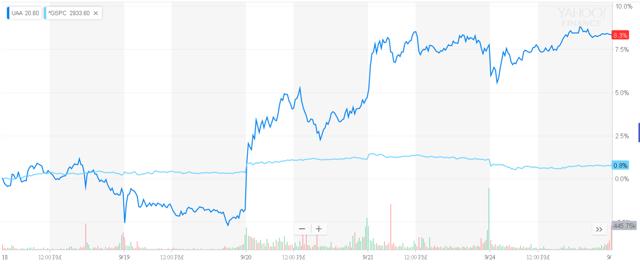
Here’s how the math works – we have a $10m charge which brings guided (actual) operating income down $10m and (adjusted) income up by $10m – but only at the lower end. Somehow, the market was fooled into believing this was positive.
(Source: Yahoo Finance)

It appears UA has yet again, adjusted its earnings to paint a more optimistic picture. Aside from the fact that the $10m adj op income raise at the low end ($0.02 raise at low end adj EPS) from severance is hardly positive, there’s two key takeaways the market seems to have missed – 1) the top end of guidance was not raised and 2) UA did not update revenue and gross margin guidance. The former likely implies that UA was heading for the low end of its initial guidance while the latter indicates little improvement from the demand side.

But that’s not all. Here’s UA’s last word on the updated guide:

“The reduction in workforce…represents the final component and update to the company’s 2018 restructuring plan”

If that sounds familiar, one only has to look back to the 4Q17 call when management made a similar promise:

“Also, important to note that we anticipate the majority of our restructuring to be completed in the first half of 2018”

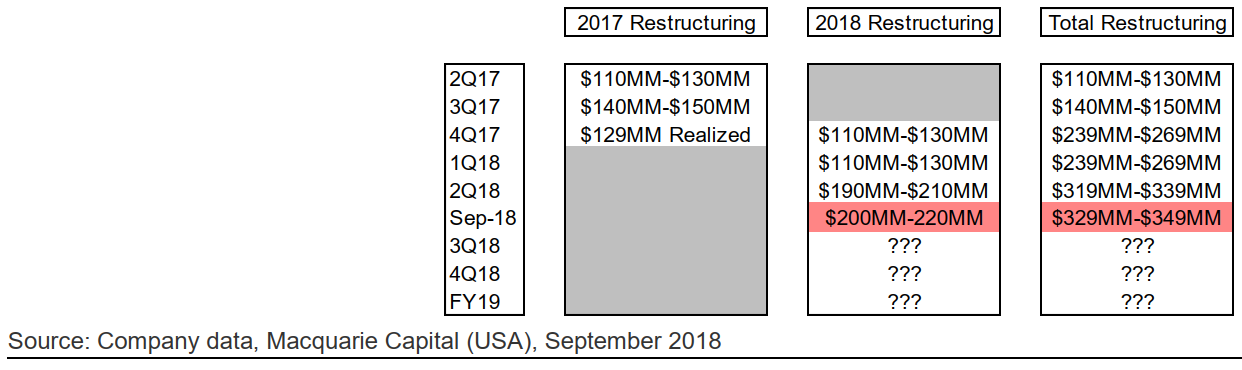
Immediately after, UA announced a new 2018 restructuring program which has ballooned from $110-130m to $200-220m as of Sept . Here’s a nice compilation by Macquarie:
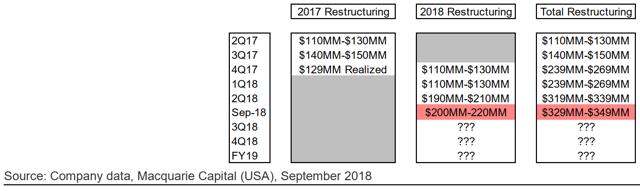
Notably, that brings total restructuring costs since 2017 to a staggering $350m at the upper end. Here’s the thing though – UA has been using some form of restructuring as a vehicle to adjust earnings for a very long time now. Pre-2017, explanation for the one-offs ranged from the Dickerson era (“product flow” and “improving customer service levels”) to the Molloy-era (everything from “promotions” to “foreign exchange rates”).

Here’s how the rationale behind the elevated inventory was explained while Dickerson was CFO:

Event

Dickerson-era Updates

2015 Investor Day

“First, on the near term — over the course of the rest of this year and through 2016, we are focused on delivering our products to our consumers more timely, specifically on key seasonal floor set dates. This focus specifically in comparison to some prior years’ challenges will result in elevated inventory growth rates over this time frame to flow product earlier

3Q15

“Switching over to inventory, as we outlined in our Investor Day, over the next few quarters we are focused on delivering our products to our consumers more timely, specifically on key seasonal floor set dates. We anticipate this will result in elevated inventory growth rates over this period to flow product earlier.

4Q15

“Finally, inventory. As we previously stated, our focus is on delivering our products to our consumers in a more timely manner and improving our customer service levels. As a result, we continue to expect inventory growth rates to be slightly elevated above the revenue growth rate in the front half of 2016, with growth rates expected to level off and be in line with revenue growth in the back half of 2016.”

(Source: Under Armour)

Chip Molloy was a lot more straightforward as CFO – here’s how his narrative evolved:

Event

Molloy-era Updates

1Q16

“As previously mentioned, the strategy to improve wholesale, customer service levels resulted in elevated inventory investments beginning in the second quarter of last year. We expect the growth in inventory will be more in line with sales as we begin to anniversary the strategy during the second quarter of this year

2Q16

“Inventory for the quarter increased 30% to $1.1 billion, compared to $837 million at June 30, 2015. As we noted last quarter, we are beginning to anniversary the strategic inventory investments that we implemented in the second quarter of last year, and expect the growth in inventory to remain relatively in line with sales throughout the remainder of the year

3Q16

“In the quarter, gross margin declined more than planned, driven predominantly by higher-than-expected promotions, both the volume and rate of liquidations, and foreign exchange rates. Despite liquidations having been a headwind on margin rates for most of this year, we now believe that our inventory position is healthier and liquidation should not have the same negative impact moving forward”

4Q16

“In our efforts to manage the brand appropriately for the marketplace, we are planning for inventory growth to be higher than revenue growth for the first three quarters of 2017 and coming more in line with revenue growth during the fourth quarter.

(Source: Under Armour)

The difference between then and now is that UA’s restructuring has expanded far beyond inventory one-offs – the asset and labor cost base has also been trimmed substantially.

2Q18

Sep-18

Pre-Tax Restructuring & Related Charges

$190-210m

$200-220m

Cash Charges

Up to $155m

Up to $155m

-Facility & Lease Terminations

Up to $75m

Up to $75m

-Contract Termination & Other

Up to $80m

Up to $90m

Non-Cash Charges

Up to $55m

Up to $55m

-Inventory

Up to $20m

Up to $20m

-Asset Impairment

Up to $35m

Up to $35m

(Source: Under Armour, Author)

But it may not be enough. In a follow-up with an analyst, management disclosed the following – 1) “the full fruits of the new Frisk era” are “not expected to hit full stride until FY20”, and 2) “Construction costs for UAA’s NYC Flagship have been pushed back until at least late 2019 (and potentially 2020).” In other words, FY19 is going to be another restructuring year for UA. That makes it the fifth consecutive restructuring year.

With high-flying expectations already embedded in next year’s consensus expectations ($0.31 FY19 EPS; +63% YoY implied), it will be interesting to see how the market reacts when the news finally hits.

Don’t Trust the Disclosures

Unbeknownst to most, the restructuring update actually came on the heels of a curious letter from the SEC. Here’s the two comments the SEC noted in its letter to UA:

Comment 1:

“You state that as of December 31, 2017, no impairment of goodwill was identified and the fair value of each reporting unit substantially exceeded its carrying value. We also note that your Latin American segment has experienced operating losses in the past three years.”

Comment 2:

“You present a full non-GAAP income statement for the quarter ended March 31, 2018 when reconciling non-GAAP measures to the most directly comparable GAAP measures. Please tell us how your presentation complies with the guidance in Question 102.10 of the Non-GAAP Compliance and Disclosure Interpretations”

The letter (dated May 23 2018) required a response within 10 business days, a window which UA was unable to meet.

“The comment letter requires that the Company respond within ten business days or inform the Staff when the Company will respond. As discussed with Ms. Suying Li, we hereby request an extension to respond by no later than June 15, 2018. This additional time will enable the necessary internal review related to the Company’s response to the comment letter

Now, on its own, this wouldn’t be a big deal. But a look into UA’s SEC correspondence history indicates a curious pattern – barring one occasion, UA has never been able to respond within the allotted window. In fact, UA has almost always needed 20-30 day extensions.

Query Year

Request for Extension

May 2011

Aug 2011

Oct 2011

Dec 2011

May 2017

May 2018

(Source: SEC)

Clearly, the SEC is asking some tough questions.

When they did finally answer though, UA’s (delayed) reply to SEC comment 1 provided some insight into how they’ve been accounting for their international units.

Per UA management, despite the LatAm business posting three consecutive years of losses, “the fair value of the reporting unit exceeded its carrying amount by approximately $130.3 million”. If that boggles the imagination, here’s UA on how they arrived at the estimate – 1) using a DCF model, management has assumed long-term profitability, 2) revenue assumed to grow at sub-41%, 3) gross margins also assumed to grow via higher DTC contribution, 4) SG&A assumed to fall as a proportion of revenue.

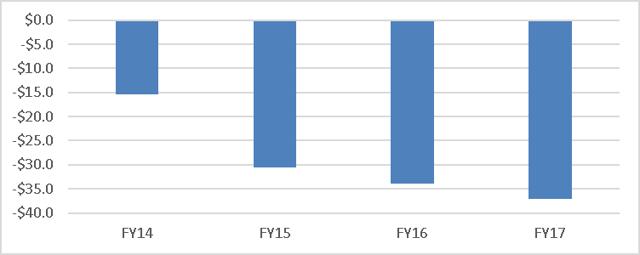
All these expectations are fine and dandy but here’s the reality of UA’s LatAm unit – it hasn’t just been loss making at the EBIT-level for three years, it’s been negative for four.
(Source: Under Armour)

Meanwhile, LatAm sales growth has been slowing significantly – 2Q only saw a 7% rise YoY with no sign of a turnaround in margins. Yet, UA has somehow been allowed to input aggressive growth and margin assumptions into the model.

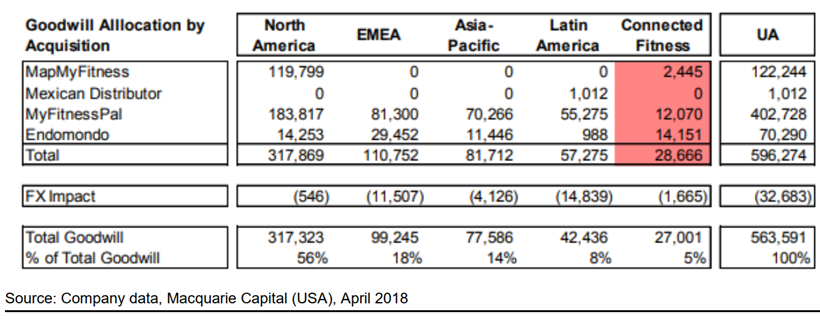
The $130m LatAm “headroom” is especially strange. As I’ve highlighted in the past, almost all of UA’s goodwill is tied up in Connected Fitness (MapMyFitness + MyFitnessPal + Endomondo). Because of the way Plank as Chief Operating Decision Maker (“CODM”) has allocated the goodwill, LatAm’s ~$40+m in goodwill is mainly tied up in Connected Fitness (“CF”) with a tiny portion (~$1m) tied to the actual LatAm operations.
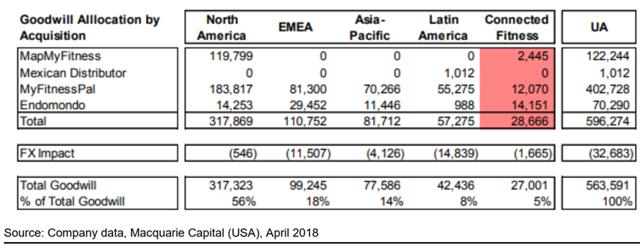
So, it makes sense that UA hasn’t written down any LatAm goodwill – virtually all of it is Connected Fitness-related and thus, unrelated to the operating losses. UA’s response detailing the $130m headroom without clarifying the source of LatAm goodwill is interesting.

To the second SEC comment re non-GAAP P&L, UA said –“We respectfully acknowledge the Staff’s comment and undertake that in future filings we will reconcile our non-GAAP measures to the most directly comparable GAAP measures without presenting a full non-GAAP income statement.”

Now, all this raises some interesting questions – 1) why is UA being allowed free rein to input unrealistic assumptions into the LatAm DCF, 2) are they using similar methods to stave off a major CF goodwill impairment, and 3) why was UA not more forthcoming about its goodwill composition with the SEC?

Most importantly, just what is going on with UA’s auditor?

Don’t Trust the Auditor

UA’s auditor PricewaterhouseCoopers (PwC) has been in place for a while now at ~15 years. There are two ways to interpret long tenures – that they’ve been around long enough to know their way around UA’s accounting or that they’ve been around too long and have gotten too cozy with the company.

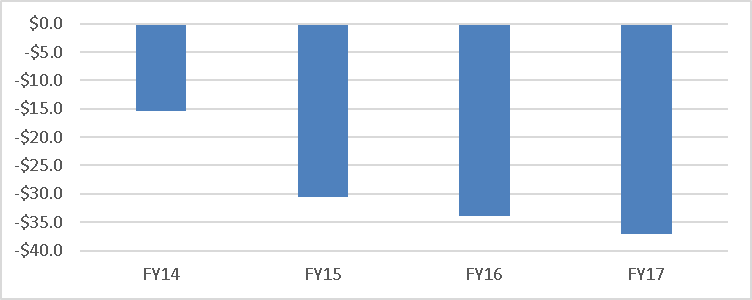
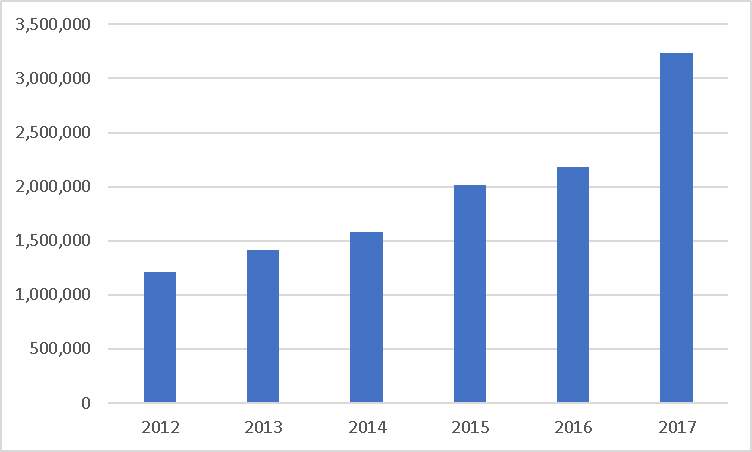
If PwC’s recent fees are anything to go by, the UA gig isn’t just lucrative, it gets more and more lucrative by the year. Here’s UA’s audit fees trend:
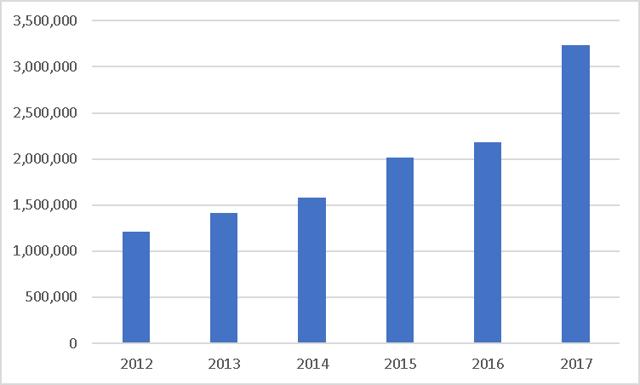
(Source: Under Armour)

Note the sharp rise in FY17 – audit fees rose ~48% in one year. Including everything else (audit-related, taxes and all other fees to the auditor), UA paid its auditor a grand total of $3.8m in FY17, a staggering 56% YoY pay hike. It also represents an eye-popping tripling in fees since FY12.

Now, there’s a few reasons why this might be the case, with the most innocuous explanation being UA’s growth (unlikely when benchmarked vs similar growth cos). The more likely reason in my view, may be that the audit may be getting more extensive e.g. digging into areas where results are uncertain.

Don’t Trust the Board

While the media fixates on the deficiencies of Tesla’s (TSLA) governance, UA’s is just as bad, if not worse. With Kevin Plank wearing the CEO/ Chairman/ Founder/ CODM hats while controlling the shareholder vote, there really isn’t much governance here at all.

I noted some interesting points on UA’s Board breakdown – 1) Seven out of ten Board members are at or past the age of 60, 2) Only one has accounting expertise, and 3) The members hold a large number of management roles and Board positions elsewhere.

Name

Position

Committee

Age

Accounting Expertise?

Kevin Plank

Chairman/ CEO

46

George W. Bodenheimer

Acting Chairman of ESPN, Inc.

Comp

60

Douglas E. Coltharp

Executive Vice President and Chief Financial Officer, Encompass Health Corporation

Audit; Finance (Chair)

56

Jerri L. DeVard

Executive Vice President, Chief Customer Officer of Office Depot, Inc.

Comp

60

Mohamed El-Erian

Former CEO and Co-Chief Investment Officer of PIMCO

60

Karen W. Katz

President and Chief Executive Officer, Neiman Marcus Group LTD LLC

Audit; CG; Finance

61

A.B. (“Buzzy”) Krongard

Former Chief Executive Officer and Chairman, Alex.Brown, Incorporated

Audit (Chair)

82

William R. McDermott

Chief Executive Officer and Executive Board Member, SAP SE

CG (Chair)

57

Eric T. Olson

Admiral, U.S. Navy (Retired) and Former Commander, U.S. Special Operations Command

CG

66

Harvey L. Sanders

Former Chief Executive Officer and Chairman, Nautica Enterprises, Inc.

Comp (Chair)

68

(Source: Under Armour, Author)

Now, UA’s Board also has a bit of an “old boys club” feel and conflicts of interest are rampant. For instance, Olson, who has served with Krongard on the board of Iridium (IRDM), was recommended by Krongard to the UA Board. Meanwhile, Bodenheimer serves with Plank on a separate Board, which may bias his judgment as an independent director.

The low female representation is telling as well.

Besides Plank, Krongard is the key piece – as lead independent director, he acts as the “liaison between the non-management directors of the Board and the Chairman, CEO and President, Kevin Plank and the other members of our management team.” On the UA site, Krongard is listed as the former CEO and chairman of Alex Brown Inc. But his Alex Brown days do not begin to do justice to Krongard’s colorful history.

In fact, Krongard was at some point the executive director at the CIA, following which he held board positions at Blackwater and ArmorGroup. During his tenure at both these companies, he was no stranger to conflicts of interest, for instance, he was brought onto the Blackwater advisory board while his brother (then State Dept inspector general) was tasked with investigations into the firm. Similarly, ArmorGroup faced allegations of counter-intelligence failures and security breaches during his tenure.

A recent lawsuit (see Andersen et al vs Plank et al) highlights, on April 25, 2016, Krongard sold 16,800 personally held shares of Under Armour stock for total proceeds of approximately $762,849.36.

(Source: Andersen et al vs Plank et al)

The timing of this was highly suspicious considering it came right on the heels of the company raising guidance on April 21, 2016. In fact, Krongard seemed to have sold his shares at the same time as fellow Board members Plank and Sanders (ironically the compensation committee chair). From the lawsuit:

“In total, the 933,600 shares sold by Plank, Krongard, and Sanders, and the $39.8 million received from those sales, within mere days after the Company raised guidance on April 21, 2016, represent approximately 19% of the total shares sold and 11.8% of the total proceeds from such sales by all Insider Selling Defendants during the Relevant Period”

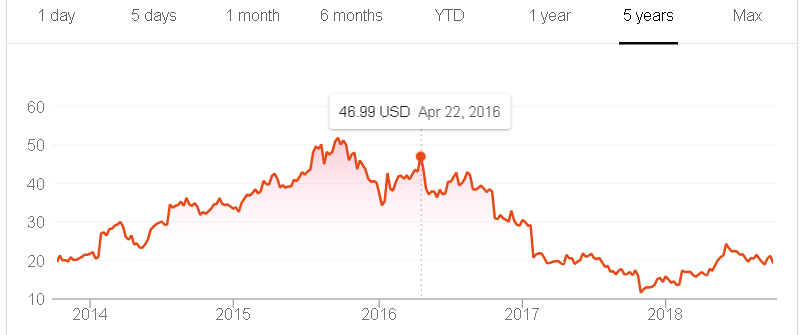
Interestingly, the slew of insider sales also came right before UA’s rapid downfall in 2016 and 2017.
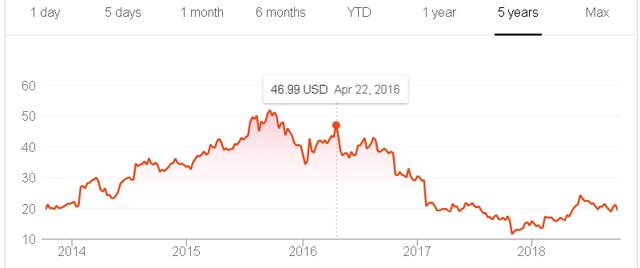
(Source: Google Finance)

It isn’t just the audit (Krongard) and compensation (Sanders) chairs that have colorful backgrounds though, finance chair (Coltharp) also has a controversial history. While at Saks, Coltharpwas relieved of responsibilities for accounting and financial reporting matters… in connection with an internal investigation into improper collections of vendor markdown allowances.” He later joined Healthsouth (now Encompass Health), a company plagued by accounting fraud, where he currently serves as CFO.

Meanwhile, McDermott (CG chair) currently runs SAP, where UA is a client. Although UA’s Board claims the relationship is immaterial and has no impact on McDermott’s independence, it seems strange that all four committee chairs either have controversial backgrounds, conflicts of interest or both.

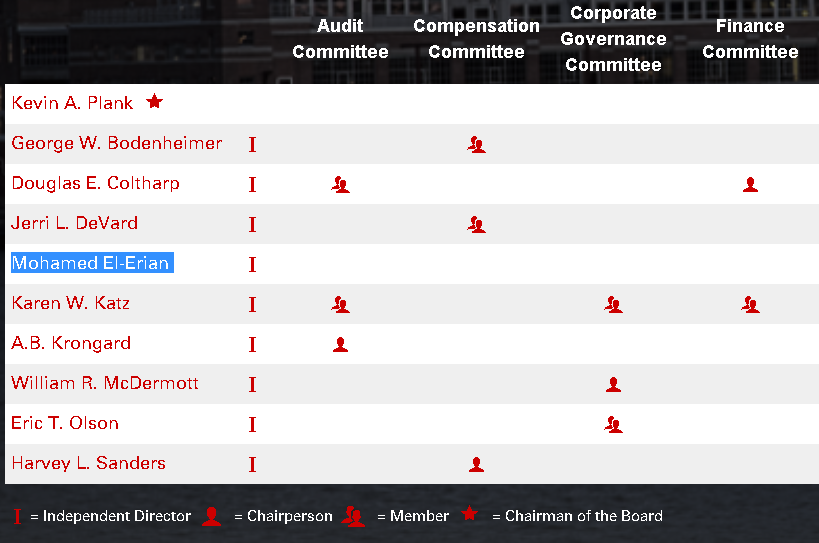
It will be interesting to see how the addition of El-Erian impacts governance. As things stand, I’m not sure he’ll be making much of an impact anytime soon – per the UA site, he isn’t (yet) on any committee:
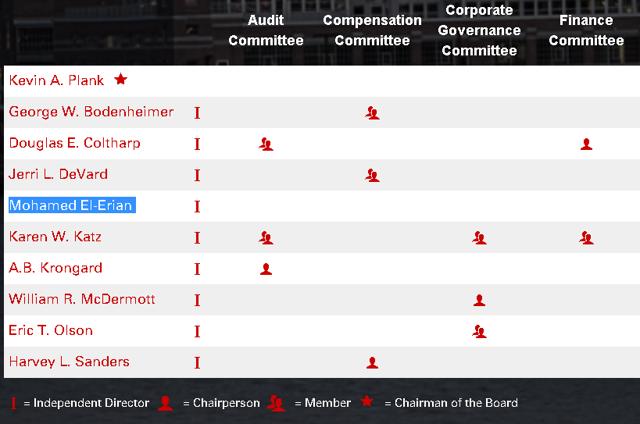
(Source: Under Armour)

Besides, there’s only so much one man can do. From what I gather, El-Erian holds so many different roles, it seems unlikely that he will be able to devote the time necessary to address UA’s governance deficiencies. Here’s a list of some of his roles:

Institution

Position

Carnegie Endowment for International Peace

Vice chair

National Bureau of Economic Research

Exco member

Capital Campaign for Cambridge University

Co-chair

King Abdullah University of Science and Technology (KAUST)

Board member

The Pegasus School

Board member

Microsoft Investment Advisory Committee

Chair

Council on Foreign Relations

Member

Allianz

International advisory committee

Allianz

International executive committee

Allianz

Chief Economic Advisor

Investcorp

International advisory committee

Under Armour

Board member

(Source: Author, El-Erian Website, Bloomberg)

Contrary to popular perception, I don’t think the addition of El-Erian is in the best interest of shareholders. Seemingly expert board members such as El-Erian add credibility but only possess tangential expertise and thus, cannot sufficiently challenge management. The busy schedule doesn’t help either and it wouldn’t surprise me if El-Erian ends up nothing more than a symbolic figure on the UA Board.

Don’t Trust Plank

UA’s governance issues really stem from Plank’s lack of accountability. UA’s share class structure (approved by the Board without question) – one-vote-per-share Class A, no-vote per share Class C, and ten-votes-per-share Class B stock – is designed to entrench Plank’s control over UA.

That’s a big problem – Plank is widely credited with promoting an overly aggressive culture within UA and since 2015, has been operating with virtually no check and balance. Here’s a particularly interesting excerpt I came across from a the Andersen lawsuit (see Andersen et al vs Plank et al):

“Within Under Armour, instructions for determining growth forecasts were very simple: take what you sold last year and add 20%. The Company’s “top down” aggression came directly from Plank. Plank’s obsession with the 20% growth streak drove the Company’s revenue growth-at-all-costs strategy.”

Along with UA, Plank also has interests in businesses such as a whiskey distillery, horse racing, venture capital and property development among others. The latter was a major source of controversy due to a related party transaction which occurred in 2016 where Plank (via Sagamore) sold a parcel of land to UA for $70.3m (more than twice the initial purchase price two years earlier).

In response to King’s demand letter dated May 25 2017 (see King et al vs Plank et al), UA came up with the following breakdown to justify the inflated price (note the inclusion of a $31m lease buyout).

Value ($)

Cost

35m

+Lease buyout

30.6m

+Development, planning and carrying cost

6.4m

-Loss to Sagamore

1.5m

Total Purchase Price

~70.3m

(Source: UA Review Group)

Meanwhile, a UA rep, Diane Pelkey has been posting the following PR statement in response to media coverage (see comment section here):

“Kevin Plank never made money on the transaction with Under Armour. In fact, he actually sold the land to the company at a loss. Moreover, this purchase is going to enable the company to develop a headquarters campus that can support the company’s long-term growth plans. The company followed a thorough process in reviewing and negotiating the transaction, using independent advisors, including Ernst & Young, with close oversight of the company’s Audit Committee to ensure the transaction was fair to the company and free of any potential conflicts.”

Very noble of Plank to take on losses to fund the latest UA headquarters. In fact, Plank claims UA faced a “pressing need for ~100,00 sq ft of office space with even more thereafter” as justification for the purchase in June 2016.

Yet, barely a year later, UA disclosed that their cost base was far too large and needed to be restructured – so much for the “pressing need”. From the 3Q17 call:

“Walking hand-in-hand with this is the need to address our cost infrastructure, which is built for a much larger company than we currently are”

In fact, Plank’s secretive Port Covington real estate purchases began in 2012 after his plans to expand UA’s Locust Point HQ was scuttled by the Baltimore Museum of Industry. Here’s Plank’s reaction in a later interview:

“Number one, I’ve got the engine in Under Armour. Number two . . . I can afford to make these decisions, so why am I waiting on [the Museum of Industry] board of directors?”

Through Marc Weller, who heads Sagamore Development (Plank’s property development co), Plank began discreetly acquiring land in Port Covington that year. His intention was twofold – to sell some of the land to UA for its future HQ, and to develop a mixed-use neighborhood anchored by UA’s HQ.

Throughout this period, Plank discreetly made Port Covington acquisitions totaling over 160 acres at ~$114 million.

Per a Baltimore Sun piece:

“The use of names and addresses that didn’t tie back to Kevin was all very intentional,” Weller said. “We wanted to be successful in acquiring as much as possible as quickly as possible.”

Companies discreetly owned by Plank purchased his first Port Covington property at a foreclosure auction.

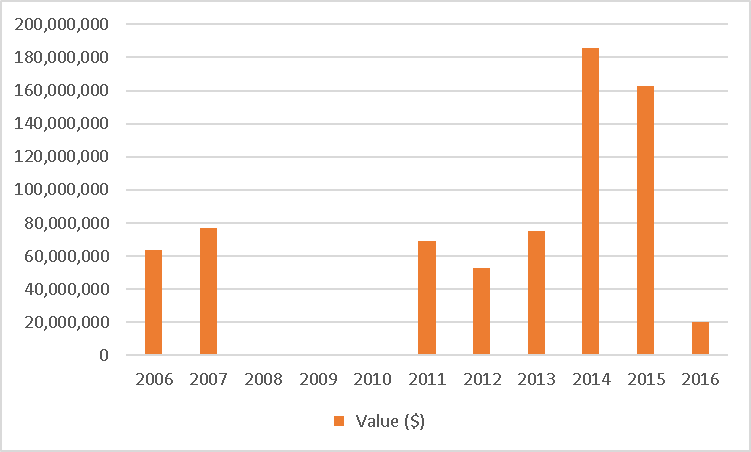
Plank sold well over $300m worth of stock into 2014, with the massive sales continuing into 2016, likely to fund the Port Covington development.

In fact, his total stock sales since listing came in at well over $700m.
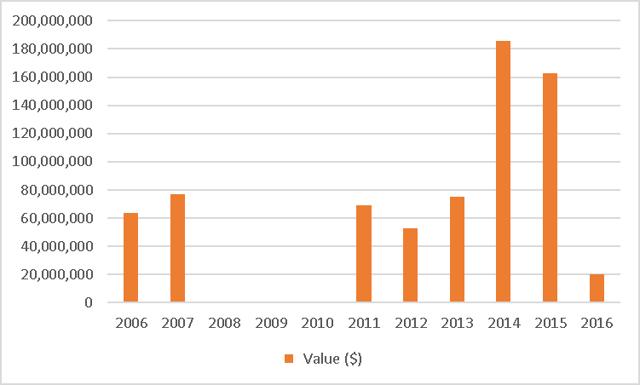
(Source: Insider Monitor, Author)

Per news articles cited in the King lawsuit (see King et al vs Plank et al), “Sagamore is expected to make $400 million from land sales during the multidecade project, according to an analysis conducted for the city.”

Here’s where it gets dicey for UA shareholders – assuming Plank has been funding Port Covington via UA share sales, would that not imply that UA shareholders have been subsidizing the project? The strategic use of UA’s HQ as a focal point of the development also likely contributed to the funding etc yet, all the upside accrues to Sagamore/ Plank.

Other notable related party transactions include UA’s lease for jet aircraft and a helicopter as well as industrial space and hotel accommodation (all linked to Plank/ Plank Industries and yes, all okayed by the Board, no questions asked).

You Cannot Fool All of the People All of the Time

With the spotlight shining firmly on Tesla’s governance deficiencies, investors may want to check out Under Armour as well. UA’s constant use of restructuring vehicles and aggressive assumptions to mask its busted growth model can only last so long before the market sees UA for what it truly is.

From a valuation perspective, UA looks extremely lofty – the “hockey stick” needed to hit FY18 is already well-known, but FY19 consensus looks way too high as well. With UA already writing off FY19, it wouldn’t surprise me if we see a big reset and consensus’ $0.31 FY19 EPS (implying ~62x fwd PE) gets cut in half. In fact, I don’t see UA’s earnings power being any higher than high-teens EPS. And that’s being generous on margins – I’ve assumed flat gross margins and SG&A going forward. Tack on a 30-40x multiple and you’d have to stretch far to get much higher than a MSD-HSD PT for the stock. With a bit of patience, there’s significant downside to be realized here.

It’s hard to say when the market will finally (de-)value UA accordingly – I’d like to think value/ patience is its own catalyst. As the saying goes:

“You can fool all the people some of the time, and some of the people all the time, but you cannot fool all the people all the time” – Abe Lincoln

Disclosure: I am/we are short UAA.

I wrote this article myself, and it expresses my own opinions. I am not receiving compensation for it (other than from Seeking Alpha). I have no business relationship with any company whose stock is mentioned in this article.

Facebook Suffered a Stunning Attack That Affected 30 Million Users. Check This Facebook Page Now to See If You're One of the Victims

In a way, this is good news, given that when Facebook previously said it thought as many as 50 million users had been affected. 

But Facebook is also describing some of the data that was accessed, and it’s truly exhaustive. Before we get too deep into the weeds of how Facebook says the attack happened and what it’s doing about it now, here’s how to tell if you’re one of the 30 million or so people affected.

On that page, you’ll see a roughly 335-word description of the issue, followed by a light blue box. If everything’s okay, you should see a simple message within the box:

Is my Facebook account impacted by this security issue?

Our investigation is still ongoing, but based on what we’ve learned so far, the attackers did not gain access to information associated with your Facebook account.

If you see anything different, at least you’ll know that there’s something to be concerned about. Facebook says that “in the coming days” it will send: 

customized messages to the 30 million people affected to explain what information the attackers might have accessed, as well as steps they can take to help protect themselves, including from suspicious emails, text messages, or calls.

While you’re doing this, you should also take the time to check your Facebook privacy settings, as I described how to do previously. You might truly be surprised by how much data Facebook has on you.

In the meantime, here’s the overview of what Facebook says happened here:

  1. First, attackers exploited a vulnerability in the site’s code that apparently resulted from three separate bugs, from July 2017 to September 2018. In short, it allowed hackers to generate tokens that allow access to user profiles.
  2. The attackers had access to a limited number of accounts to begin with, and it’s not clear if these were bogus to begin with, but they were connected to other “friends” on the site. Then, they “used an automated technique to move from account to account so they could steal the access tokens of those friends,” and then friends of those friends. Ultimately this got them access to about 400,000 people.
  3. Ultimately, the hack metastasized across the network, accessing about 30 million total profiles.

Not every account was accessed in the same way. Facebook says for 15 million of the compromised accounts, the attackers basically just got names and contact details such as “phone number, email, or both, depending on what people had on their profiles.”

For another 1 million people, the hackers got access, but weren’t able to obtain any information.

The 14 million remaining people had the most information accessed, however, including:

  • names
  • contact information
  • username 
  • gender 
  • locale/language
  • relationship status
  • religion
  • hometown
  • self-reported current city
  • birthdate
  • device types used to access Facebook
  • education
  • work
  • the last 10 places they checked into or were tagged in
  • website
  • people or Pages they follow, and
  • their 15 most recent searches. 

That’s truly a mother lode. I suppose it’s that that there doesn’t seem to be any immediate indication that financial information was accessed.

And Facebook is quick to point out that the attack appears limited to Facebook personal accounts, not Messenger, Instagram, WhatsApp, Oculus, or other Facebook products. But the investigation is clearly ongoing.

“As we look for other ways the people behind this attack used Facebook,” the company said, “as well as the possibility of smaller-scale attacks, we’ll continue to cooperate with the FBI, the US Federal Trade Commission, Irish Data Protection Commission, and other authorities.” 

Here's How to Prevent Your Company from Exploding into a PR Fire

The key, of course, is prevention. Companies need a robust system that keeps small problems just that. There must be instructions with clear, concrete steps to prevent smoke from becoming fire. Here are tips on how to help prevent your company from getting embroiled in a crisis:

1. Analyze Your Risks

2. Get Every Level Involved

I’m a believer that every employee should be CEO-ready. Similarly, every employee should be crisis-ready, too. Seek input from every level of your company, from the lowest-level employee up to Chairman of the Board. Have them identify the potential risks they see. Also have them consider how they would fix problems identified by others. Sometimes the solution is simple, but you’d never know it because of a lack of communication across teams. Then, take the opportunity to train every employee on your crisis management plan, including how to identify potential crises before they get to that stage.

3. Monitor and Vet Social Media

Social media is a blessing and a curse to business. It’s a wonderful platform to deepen ties with current customers, interact with new consumers, and develop fans of your brand. Businesses need social media, but it comes with risk. One simple tweet can start a firestorm of controversy. If your company is active on social media, you need someone constantly monitoring your feed. If a customer reaches out with a problem, get on it immediately. Importantly, you also need a variety of people to vet what you plan to publish on social media. Many a well-intentioned tweet has opened the door to unexpected criticism.

4. Have Fire Extinguishers at the Ready

No matter the planning and prevention, no business is perfect. There will be small problems that grow into big problems, and you need a failsafe in place to stop the bleeding. This includes a clear path for employees to escalate information when they see a crisis brewing. If the leader is on an extended absence, you need to know who will assume the leader’s crisis management responsibilities. This also requires regular training of all employees on your plan.

5. Ownership

It’s inevitable that bad things will happen. How you deal with them will define your company in the social consciousness. If the cover-up is always worse than the crime, then the denial of a crisis is always worse than the underlying problem. If you messed up, or sometimes even if it wasn’t your fault, own it. Transparency and honesty will buy you credibility with consumers, even if the rest of your response isn’t perfect.

Data privacy rules spoiling fintech boom, says industry group

HONG KONG (Reuters) – Data privacy rules in Asia are limiting the spread of financial technology, an industry body said on Thursday, calling on regulators to set out broad principles rather than precise rules.

FILE PHOTO: A photo illustration shows a USB device being plugged into a laptop computer in Berlin July 31, 2014. REUTERS/Thomas Peter/File Photo

Companies around the world want to make better use of the large pools of data they have to both cut costs and offer additional services. But governments and regulators in Asia and elsewhere are tightening rules on how that data is used.

“Governments in Asia say that they support fintech, and they want fintech firms to enter their market, but data privacy rules are a major stumbling block,” Paul Hadzewycz, senior associate at the Asian Securities Industry and Financial Markets Association (Asifma), told Reuters.

In a report on Thursday, Asifma urged regulators to avoid an “exhaustive and prescriptive list” of rules and set principles that allow companies to operate “confidently across borders and enter new markets.”

Some 13 countries in Asia have data protection rules, Stephen Wong, Hong Kong’s commissioner for data privacy, said at the Refinitiv Pan Asian Regulatory Summit in Hong Kong on Tuesday.

Aside from the privacy rules, companies also face varied, and sometimes conflicting, requirements imposed by financial regulators, privacy commissioners and cyber security bodies in Asia, Hadzewycz said.

Another industry concern are rules that prevent a company from storing customers’ data outside their country.

Vietnam has set rules to force global technology companies like Facebook (FB.O) and Alphabet Inc’s (GOOGL.O) Google to store user data in the country, and India is planning similar legislation..

“Regulators who are bringing in data localization rules are painting themselves into a corner and are hurting their attractiveness as a market to fintech firms,” Hadzewycz said.

Reporting by Alun John; editing by Darren Schuettler

How Jamal Khashoggi's Apple Watch Could Solve His Disappearance

Saudi dissident and Washington Post columnist Jamal Khashoggi went missing in Turkey last week. The outspoken critic of Saudi Arabia’s war on Yemen walked into the Saudi consulate in Istanbul at 1 pm on Tuesday, October 2, to obtain documents for his upcoming wedding. Within two hours, Turkish security officials now say, Khashoggi was dead—assassinated by a team of Saudi agents.

Saudi officials deny the allegations, and it’s unclear how Turkish officials—some of whom have spoken to news outlets on the condition of anonymity—concluded that Khashoggi had been killed. But as Reuters reported Wednesday, two of those officials say that Khashoggi’s Apple Watch has factored into their ongoing investigation.

“We have determined that it was on him when he walked into the consulate,” the security official said. The question now is whether the wearable transmitted any forensically useful information to either of his mobile phones, which he left with his fiancée, Hatice Cengiz, before entering the building. “Intelligence services, the prosecutor’s office and a technology team are working on this,” the official told Reuters. “Turkey does not have the watch so we are trying to do it through connected devices.”

Depending on which model of Apple Watch Khashoggi had strapped to his wrist and his proximity to his phones, his wearable could have transmitted data about his location, his activity, or his heart rate to his devices—any and all of which could be used to help make clear what happened inside the consulate during the two hours in which Turkish officials say Khashoggi was assassinated.

Fitness trackers have recorded all three forms of data during instances of violent crime. Earlier this year, police in San Jose, California, used data from a murder victim’s Fitbit to identify the eight-minute window in which her heart rate had spiked, slowed, and finally stopped—timepoints they cross-referenced with video footage to place her accused murderer at the crime scene during the same period.

In 2017, a woman running in Seattle’s Golden Gardens Park stopped to use the restroom when she was assaulted by a man hiding in a bathroom stall. She fought back and managed to escape. The GPS on her Garmin Vivosmart watch recorded the violent encounter in the form of jagged red lines, overlaid atop an aerial view of the park’s restroom.

And in 2015, Connecticut police used activity data from a murder victim’s Fitbit to show that she had been walking around her house at the same time her husband claimed they were both being attacked—evidence that led investigators to question the husband’s account of his wife’s death and place him under arrest.

In other words: Data from Khashoggi’s watch could very well shed light on what happened to him inside the consulate, corroborating the claims of Turkish officials—or contradicting them. In 2015, investigators in Pennsylvania used data from an activity tracker to show that a woman, who claimed to have been sexually assaulted during a break-in, had been walking around when she told police she had been asleep.

“She inserted the device into the crime scene when she told us it was torn off her,” says Christopher Jones, the detective in the East Lampeter Township Police Department who investigated the case. “I figured the activity data from the tracker would either match with her story, or go against it. And in this case they contradicted her account.”

Fitness trackers and smartwatches are far from perfect witnesses. They can mistake hand-movements for footsteps, and their optical heart rate sensors are notoriously finicky. But newer models are more accurate and increasingly more capable. Apple’s first generation wearable checked in on the wearer’s heartbeat every ten minutes—and only if they weren’t moving. The latest iteration of the Apple Watch keeps constant tabs on your ticker, and can even monitor for abnormal heart rhythms.

Jones, who has since spoken at conferences on the use of fitness tracker data in criminal investigations, says he hears more and more about them factoring into detective work, but he’s yet to hear of a case that hinged entirely on data from a wearable. “Ultimately it’s just one piece of the entire puzzle—and when you can use it to corroborate other physical evidence, then it’s a good piece.”

But in the investigation over Khashoggi’s disappearance, compelling evidence, physical or otherwise, has yet to emerge. What traces do exist—flight logs, surveillance footage, whispers of a bone saw—hint at foul play, kidnapping, and perhaps a grisly end. Smartwatch data alone might not be able to determine what really happened, but as more and more devices continue to accrue new and better tracking abilities, the day when it is could be fast approaching.


More Great WIRED Stories

SoftBank in talks to take majority stake in WeWork: source

SAN FRANCISCO/NEW YORK (Reuters) – Japan’s SoftBank Group Corp (9984.T) is in discussions to take a majority stake in shared office space provider WeWork Cos, a source familiar with the matter said, a deal that would increase one of its biggest bets on a late-stage U.S. startup.

FILE PHOTO: An employee works behind a logo of Softbank Corp at its branch in Tokyo March 2, 2011. REUTERS/Toru Hanai/File Photo

Pricing and other details have yet to be firmed up, the source said, adding that it was not a done deal.

A logo of U.S. co-working firm WeWork is pictured during a signing ceremony in Shanghai, China April 12, 2018. Picture taken April 12, 2018. Jackal Pan via REUTERS

A second source also said SoftBank is in talks about a major new investment in WeWork. Both spoke on the condition of anonymity as the details of the talks were private.

The Wall Street Journal reported earlier that SoftBank’s investment could be between $15 billion and $20 billion and would likely come from SoftBank’s Vision Fund.

WeWork and SoftBank declined to comment.

SoftBank and its Vision Fund invested $4.4 billion in WeWork last year and the Japanese company holds two board seats.

WeWork’s prospects have been treated with skepticism by some Silicon Valley investors who see the company as an overvalued real estate play vulnerable to a property market downturn.

A majority stake by SoftBank, which has raised more than $93 billion to create the technology-focused Vision Fund, would be a shift from its more common practice of taking minority stakes in high-profile late-stage startups.

The two companies are closely entwined, with hundreds of SoftBank staff using space at the two companies’ Japanese joint venture and SoftBank considering moving its headquarters into WeWork offices.

Eight-year old WeWork is growing rapidly and in September surpassed JP Morgan (JPM.N), the biggest U.S. bank, as the largest tenant of Manhattan office space, highlighting growing demand for flexible leases.

Reporting by Heather Somerville in San Francisco and Gregory Roumeliotis in New York; Writing by Sanjana Shivdas in Bengaluru and Sam Nussey in Tokyo; Editing by Peter Cooney and Edwina Gibbs

U.S. Republican senator seeks briefings on reported China hacking attack

WASHINGTON (Reuters) – The top Republican on the Senate Commerce Committee has asked Apple Inc, Amazon.com Inc and Super Micro Computer Inc for staff briefings about a Bloomberg report that the Chinese government implanted malicious hardware into server motherboards provided by Super Micro.

FILE PHOTO: Senator John Thune (R-SD), chairman of the Senate Commerce, Science and Transportation Committee, questions executives from AT&T, Amazon, Google, Apple and Twitter on safeguards for consumer data privacy in Washington, U.S., September 26, 2018. REUTERS/Joshua Roberts/File Photo

Senator John Thune said in letters to the chief executives made public on Tuesday that he had sought staff briefings by Oct. 12 from the three companies.

“Allegations that the U.S. hardware supply chain has been purposely tampered with by a foreign power must be taken seriously,” Thune wrote.

The companies did not immediately comment on Tuesday on Thune’s letter. All have denied the report, published by Bloomberg Businessweek on Thursday.

Separately, Republican Senator Marco Rubio and Democratic Senator Richard Blumenthal wrote to Super Micro’s chief executive, Charles Liang, and asked him to provide by Oct. 17 information including when the company first became aware of the report and whether and how it investigated.

“If this news report is accurate, the potential infiltration of Chinese backdoors could provide a foothold for adversaries and competitors to engage in commercial espionage and launch destructive cyber attacks,” the senators said in their letter, which was seen by Reuters.

Apple’s top security officer, George Stathakopoulos, told Thune and other members of Congress in a letter on Sunday that the company had found no sign of suspicious transmissions or other evidence that it had been penetrated in a sophisticated attack on its supply chain.

Stathakopoulos said he would be available for briefings this week.

Reporting by David Shepardson and Patricia Zengerle; Editing by Bill Rigby and Darren Schuettler

7 Strategies to Maximize Your Productivity While Traveling

Whether you hate the idea of traveling or you actually look forward to it, it’s hard to deny that travel can sabotage your productivity–at least temporarily. It takes hours of planning and coordination to prepare for some trips, and hours to navigate airports, not to mention the actual time you spend traveling.

It can make a full day of responsibilities feel like a waste, and put you behind on achieving your goals. Fortunately, there are some helpful strategies that can make you more productive–no matter how you’re traveling.

Try using these tactics to get more done when you’re setting course on a major trip:

1. Get used to a different sleep cycle.

One of the biggest sources of productivity disturbance while traveling is the disruption in your sleep cycle. Depending on where you travel to, you could be dealing with timezone changes and jet lag, and you may not be able to get a comfortable eight hours of sleep when you’re used to getting it.

Instead, you can try a biphasic cycle or an everyman cycle, which rely on split patterns to break up your time sleeping; that way, travel may not have as big of an impact on you. The caveat here is that it takes time to get used to a new sleep cycle, so it’s best for frequent travelers only.

2. Take a private jet.

One of the biggest sources of time delay while traveling is navigating the airport; going through customs, waiting to board the plane, dealing with delays, etc., can add several unnecessary hours to your trip.

Taking a private jet allows you to circumvent most of these problems–and it’s cheaper than you think. If a few hundred dollars can save you literally hours of time, and afford you a better workspace when you’re flying, it’s likely worth the extra money.

3. Look for coworking spaces when you arrive.

Coworking spaces are popping up everywhere, so you shouldn’t have trouble finding one at your destination. Instead of going straight to a hotel or meeting, check into one of these productivity hubs; you’ll be able to get coffee, work in a peaceful environment, and if you’re up for it, socialize with other people who may be in similar situations. It’s a great way to both decompress and get more work done, so take advantage of it.

4. Rely on audio.

While you’re driving, navigating the airport, or dealing with a lack of lighting or Wi-Fi, you won’t be able to work on your most important heads-down tasks–but that doesn’t mean you can’t be productive.

Try focusing on audio-specific tasks when you can, listening to recordings of old meetings to prepare for the future, catching up on your favorite industry podcasts, and listening to audiobooks that can improve your skills or expand your professional horizons. There’s no shortage of audio content to plunder, so make good use of it.

5. Prepare travel-specific tasks.

While traveling, you won’t be able to do tasks that require multiple monitors, or meet with your teammates in person. You’ll have limited space, and in some cases, limited Wi-Fi connectivity.

Prepare tasks that you can work on under these conditions, so you don’t run out of things to do. As long as you have a few days’ heads-up, you can handle your least travel-friendly tasks in advance, and set yourself up to work offline for the next several hours.

6. Say “no” and delegate.

New things are going to come to your attention before and during your travel; for example, you might get a client email requesting a change to a piece of work you submitted. If this is the type of work that can’t be done efficiently when traveling, don’t bend over backwards trying to do it; instead, tell them you’re traveling, and not able to do it right now.

If it’s an emergency, or if you won’t be able to get to it for a while, consider delegating it to someone who can handle it.

7. Rest (if you can).

To some people, sleeping may seem like the opposite of productivity. But in reality, sleeping is one of the best things you can do for your mental energy and cognitive capacity. It can even reduce your susceptibility to illness and improve your overall physical health.

Accordingly, if it’s possible for you to take a nap during a long flight or car ride, take advantage of the opportunity. Use a face mask, a neck pillow, or some comforting white noise from your headphones–whatever you need to get some extra shuteye when you’re between destinations. You’ll thank yourself later.

Finding Your Own Style

Not everyone is going to travel the same way. For example, some people may not be able to read while in a vehicle, and some may have trouble sleeping on airplanes. The goal isn’t to fall in line with a series of productive habits, but rather to craft your own habits to maximize your personal productivity. Learn which strategies and actions suit you best, and customize your own set of approaches.

Apple tells Congress it found no signs of hacking attack

SAN FRANCISCO (Reuters) – Apple Inc’s (AAPL.O) top security officer told Congress on Sunday that it had found no sign of suspicious transmissions or other evidence that it had been penetrated in a sophisticated attack on its supply chain.

The Apple Inc. store is seen on the day of the new iPhone 7 smartphone launch in Los Angeles, California, U.S., September 16, 2016. REUTERS/Lucy Nicholson/File Photo

Apple Vice President for Information Security George Stathakopoulos wrote in a letter to the Senate and House commerce committees that the company had repeatedly investigated and found no evidence for the main points in a Bloomberg Businessweek article published on Thursday, including that chips inside servers sold to Apple by Super Micro Computer Inc (SMCI.PK) allowed for backdoor transmissions to China.

“Apple’s proprietary security tools are continuously scanning for precisely this kind of outbound traffic, as it indicates the existence of malware or other malicious activity. Nothing was ever found,” he wrote in the letter provided to Reuters.

Stathakopoulos repeated Apple’s statements to the press that it never found malicious chips or vulnerabilities purposely planted in any server or been contacted by the Federal Bureau of Investigation (FBI) about such concerns. He said he would be available to brief Congressional staff on the issue this week.

The letter follows statements on Friday by Britain’s National Cyber Security Centre and on Saturday by the U.S. Department of Homeland Security that those agencies have no reason to doubt denials from Apple and Amazon.com Inc (AMZN.O) that they had discovered backdoored chips.

Bloomberg said on Friday it stood by its story, which was based on 17 anonymous sources. Some allegations were based on fewer accounts or even a single unnamed source, Apple noted in its letter.

A Bloomberg spokeswoman did not immediately respond to questions sent on Sunday.

Reporting by Joseph Menn; Editing by Marguerita Choy

There's a Bizarre Hoax Circulating on Facebook. Here's Why it's Spreading Like Wildfire

Are you on Facebook? If you are, you’ve most likely received a repetitive, canned note (or 100) from your friends/family that is driving you into a fit of rage. If you haven’t, consider yourself lucky. However, there’s indeed an irritating hoax going around that has grabbed some serious attention. Here’s what the message says: 

Hi….I actually got another friend request from you yesterday…which I ignored so you may want to check your account. Hold your finger on the message until the forward button appears…then hit forward and all the people you want to forward too….I had to do the people individually. Good Luck! 

Spoiler: there’s no ‘clone’ account. This is just a hoax, so delete the message and be worry-free that an account or second-degree account is compromised. 

We’re all familiar with this level of chain-like-mail, but what makes this time so different? The obvious answer could be any of the following: 

  • It’s coming from friends & family — so you can trust it
  • There’s clear instruction on what to do
  • It doesn’t contain a link
  • You’re doing it through Messenger (it’s more novel), vs. a status update

However, it goes deeper than that.

We need to remember that Facebook has its fair share of ‘bad press’ (yes, there is such a thing) the past couple years, stemming from the Cambridge Analytica scandal which affected 87 million accounts. Then, all 2.2 billion Facebook users received a notice in an effort to inform them on how to protect their information. Add to this that on September 28th, hackers exploited a flaw which resulted in compromised data for 50 million accounts. Yikes. 

And what do you get when you mix that all together?

A user constantly on high-alert due to the endless loop of security & privacy concerns

The decision to forward is almost an irrational one–and an innate reaction to Facebook’s shaky history and hyper-recent exploitation. All of that creates an uncomfortable level of ‘unknown’ when it comes to privacy and, at the end of the day, your friends & family are really just trying to help inform of a potential concern. 

So, the next time you receive one of these messages, maybe take a deep breath and if you feel like a good Samaritan, let them know that they don’t need to forward the message out to anyone else–the clones aren’t here (yet).

Published on: Oct 7, 2018

The Cars of the Paris Auto Show Reveal a Quirky, Urban, Electric Future

The Renault Ez-Ultimo brings the high-end glitz to the show this year. Just because cities of the future may prioritize ride sharing over private cars doesn’t mean you should have to slum it on the way to opening night at the Opéra national de Paris.

This rounded bronze box is about as far from a production car as a concept can be (could those wheels even turn? where’s the ground clearance for cobbled streets?) but Renault says it shows a vision of an autonomous future, where passengers demand more from vehicles. In particular, the interior “reflects French elegance” with wood, leather, and marble.

Citroën went the opposite direction, unveiling a very real, very modest EV. The DS3 Crossback E-Tense is a fashionable crossover SUV, and an update on Citroen’s tres popular DS3 supermini car. The electric version comes with a 50-kWh battery—about half that of a high-end Tesla—a range of 186 miles on the generous European test cycle, and a 0-60 time of 8.7 seconds. None of those specs are going to blow buyers away, but at the right (to be revealed) price, the quirky car, with sharp angles and odd window cutouts, could rival the Nissan Leaf or Renault Zoe, as a city runabout.

Europe has taken styling cues from the US for the Peugeot E-Legend concept, albeit with a little added flair. There are plenty of muscle car hints in the styling, with a side profile reminiscent of the modern Dodge Challenger, and a Mustang-like front squint. Of course it’s a concept, so it’s electric and autonomous, and supposed to show that those things don’t have to be boring or bland.

The retro theme continues inside with velvet upholstery and fake wood screensavers for the displays when they aren’t in use. It’ll apparently have a 100-kWh battery pack and all-wheel drive, but it’s so concept-y that wise money should be on all that potentially changing, if and when the E-Legend makes it to production.

It wouldn’t be a European auto show without a city car, and Smart is the brand synonymous with cars so small they can be parked end-on to a curb. The Smart Forease moves that theme into an electric age. The rather optimistic concept banks on the future always being sunny, given that it doesn’t have a roof. Not even an optional one. (Have these people been to Europe?)

Smart has already stopped the sales of all internal combustion engined cars in the US, and if this car makes it across the Atlantic (and to reality) it could find a place in some Californian garages. The Golden State has good EV electric rebates, and as close to a guarantee of good weather as you’re going to find.

Infiniti is keeping it real with its Project Black S hybrid, based on a Q60 coupe and its V6 engine. Infiniti engineers turned to electrification, and lessons from partner Renault’s Formula 1 team (there’s the French connection) to give the machine an e-boost.

It’s a hybrid, but one that delivers performance rather than economy. The three motors add 213 horsepower to bring the total to 563, and drop the 0-60 mph time to under four seconds.

Toyota didn’t use the Paris show to unveil radical new concepts, but did introduce a term that will be new to most buyers: self-charging hybrids. This is no magical perpetual motion-type technology: Self-charging hybrids are just cars that can run on battery power, but can’t be plugged in. The type Toyota has been selling for years with the Prius, when they used to be just called “hybrids.” As they’ve gone from being radical, to commonplace, to somewhat lame given the influx of more robust electric options, Toyota is looking to rebrand to remind people that the tech is still quite clever, and does save fuel.

DHS says no reason to doubt firms' China hack denials

WASHINGTON (Reuters) – The U.S. Department of Homeland Security said on Saturday it currently had no reason to doubt statements from companies that have denied a Bloomberg report that their supply chains were compromised by malicious computer chips inserted by Chinese intelligence services.

FILE PHOTO: A U.S. Department of Homeland Security employee stands inside the National Cybersecurity and Communications Integration Center as part of a guided media tour in Arlington, Virginia June 26, 2014. REUTERS/Kevin Lamarque/File Photo

“The Department of Homeland Security is aware of the media reports of a technology supply chain compromise,” DHS said in a statement.

“Like our partners in the UK, the National Cyber Security Centre, at this time we have no reason to doubt the statements from the companies named in the story,” it said.

Bloomberg Businessweek on Thursday cited 17 unidentified intelligence and company sources as saying that Chinese spies had placed computer chips inside equipment used by around 30 companies, as well as multiple U.S. government agencies, which would give Beijing secret access to internal networks.

Britain’s national cyber security agency said on Friday it had no reason to doubt the assessments made by Apple Inc (AAPL.O) and Amazon.com Inc (AMZN.O) challenging the report.

Apple contested the Bloomberg report on Thursday, saying its own internal investigations found no evidence to support the story’s claims and that neither the company, nor its contacts in law enforcement, were aware of any investigation by the FBI on the matter.

Apple’s recently retired general counsel, Bruce Sewell, told Reuters he called the FBI’s then-general counsel, James Baker, last year after being told by Bloomberg of an open investigation of Super Micro Computer Inc (SMCI.PK), a hardware maker whose products Bloomberg said were implanted with malicious Chinese chips.

“I got on the phone with him personally and said, ‘Do you know anything about this?,” Sewell said of his conversation with Baker. “He said, ‘I’ve never heard of this, but give me 24 hours to make sure.’ He called me back 24 hours later and said ‘Nobody here knows what this story is about.’”

Baker and the FBI declined to comment on Friday.

Reporting by David Brunnstrom; Editing by Dan Grebler